Ford Madox Ford
The English author
Ford Madox Ford (1873-1939) is best known for his novels "The Good
Soldier" and "Parade's End". An outstanding editor, he published
works by many significant writers of his era.
Ford Madox Ford was born Ford Madox Hueffer in Merton, England, on Dec. 17, 1873,
the son of Dr. Francis Hueffer, a German, who was once music editor of the Times.
His maternal grandfather, Ford Madox Brown, the painter, had been one of the
founders of the Pre-Raphaelite movement, and an aunt was the wife of William
Rossetti. In 1919 he changed his name from Hueffer to Ford, for reasons that
were probably connected with his complicated marital affairs. He was educated
in England, Germany, and especially France, and it is said that he first
thought out his novels in French.
By the age of 22 Ford had written four books,
including a fairy tale, The Brown Owl, written when he was 17 and
published when he was
In 1908 Ford began the periodical English Review
in order to publish Thomas Hardy's "The Sunday Morning Tragedy,"
which had been rejected everywhere else. Other contributors included Conrad,
William James, W. H. Hudson, John Galsworthy, T. S. Eliot, Robert Frost, Norman
Douglas, Wyndham Lewis, H. G. Wells, D. H. Lawrence, and Anatole France. After
World War I Ford founded the Transatlantic Review, which numbered among
its contributors James Joyce and Ernest Hemingway.
In 1914 Ford published what he intended to be his last
novel, The Good Soldier. Out of his experiences in wartime England and
service in a Welsh regiment, he then wrote the series of novels that is chiefly
responsible for his high reputation: Some Do Not, No More Parades, and A
Man Could Stand Up, published in 1924-1926, and the final volume, The
Last Post, published in 1928. The view of war in these has been described
as detached and disenchanted, and the novels
are innovative as well as traditional. His novels were not widely read, but a
revival of interest in his work began with New Directions
In his later years Ford preferred life in Provence and
the United States, spending his last years as a teacher at Olivet College in
Michigan with the professed aim of restoring the lost art of reading. Ford
wrote more than 60 books. Among these works were volumes of poetry, critical
studies (The English Novel: From the Earliest Days to the Death of Joseph
Conrad, 1929; Return to Yesterday, 1932), and memoirs (It Was the
Nightingale, 1933; Mightier Than the Sword, 1938). Ford Madox Ford
died at Beauville, France, on July 26, 1939.
Britannica
Concise Encyclopedia: Ford Madox Ford
(born Dec. 17,
1873, Merton, Surrey, Eng. — died June 26, 1939, Deauville, France) English novelist,
editor, and critic. Ford collaborated with Joseph Conrad
on The Inheritors (1901) and Romance (1903). As the founder of
the English Review (1908), he generously encouraged younger writers. He
was gassed and shell-shocked in World War I; after the war he changed his name
to Ford. Of more than 70 published works, his best known are The Good
Soldier (1915), a novel about the demise of aristocratic England; and the
tetralogy Parade's End — Some Do Not (1924), No More Parades
(1925), A Man Could Stand Up (1926), and Last Post (1928) — which
explores the breakdown of Edwardian culture and the emergence of new values.
For more information on Ford Madox Ford, visit Britannica.com.
Columbia
Encyclopedia: Ford, Ford Madox,
1873–1939, English
author; grandson of Ford Madox Brown. He changed his name legally from Ford
Madox Hueffer in 1919. The author of over 60 works including novels, poems,
criticism, travel essays, and reminiscences, Ford also edited the English
Review (1908–11) and the Transatlantic Review (1924, Paris); among
his contributors were Thomas Hardy, James Joyce, and D. H. Lawrence. Ford's
most important fictional works are The Good Soldier (1915), a subtle and
complex novel about the relationship of two married couples, and a tetralogy
(1924–28): Some Do Not, No More Parades, A Man Could Stand Up, and The
Last Post (pub. together as Parade's End, 1950). These works reveal
the collapse of the Tory-Christian virtues under the violence and social
hypocrisy that culminated in World War I. Ford collaborated with Joseph Conrad
on The Inheritors (1901), Romance (1903), and other works. His
memoir of Conrad (1924) discusses the narrative techniques that the two writers
evolved. Toward the end of his life, Ford lived in France and the United States
and was a member of the faculty of Olivet College in Michigan.
Bibliography
See his letters (ed. by R. M. Ludwig, 1965);
biographies by F. MacShane (1965) and A. Mizener (1971, repr. 1985); studies by
F. MacShane, ed. (1972), S. Stand, ed. (1981), A. B. Snitow (1984), and R. A.
Cassell, ed. (1987).
Wikipedia: Ford
Madox Ford
|
Ford Madox Ford |
|
|
|
|
|
Ford Hermann
Hueffer, Ford Madox Hueffer |
|
|
Born: |
|
|
Died: |
|
|
Writing period: |
|
|
Debut works: |
The Shifting of
the Fire |
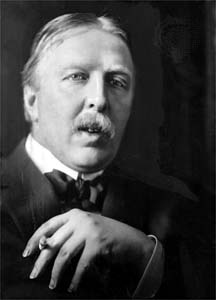
Ford Madox Ford (December 17, 1873 – June 26, 1939) was an English novelist, poet, critic and editor whose journals The
English Review and The Transatlantic Review
were instrumental in the development of early 20th-century English-language
literature. He is now best remembered for The Good Soldier (1915) and the Parade's End tetralogy.
Born Ford Hermann Hueffer, he was Ford Madox
Hueffer before he finally settled on the name Ford Madox Ford in
honour of his grandfather, the Pre-Raphaelite painter Ford Madox Brown, whose biography he had written.
·
Literary Encyclopedia entry on Ford
·
Works by
Ford Madox Ford at Project Gutenberg
·
LitWeb.net:
Ford Madox Ford Biography
|
Persondata |
|
|
NAME |
Ford, Ford Madox |
|
ALTERNATIVE
NAMES |
Hueffer, Ford
Madox; Hueffer, Ford Hermann |
|
SHORT
DESCRIPTION |
|
|
DATE OF BIRTH |
|
|
PLACE OF BIRTH |
|
|
DATE OF DEATH |
|
|
PLACE OF DEATH |
|
This entry is from Wikipedia, the leading
user-contributed encyclopedia. It may not have been reviewed by professional
editors (see full disclaimer)
© http://www.answers.com/topic/ford-madox-ford
Visited on 2008-10-18
Other interesting
bibliographies: [1]
[2]
[3] [4]
[5]
[6]

Back to First
Paper
Academic year 2008/2009
© a.r.e.a./Dr.Vicente Forés López
© Ana Mestre Climent
amescli@alumni.uv.es
Universitat de València Press