Daniel Defoe
"DeFoe
is our only famous politician and man of letters, who represented, in its
inflexible constancy, sturdy resolution, unwearied perseverance, and obstinate
contempt of danger and tyranny, the great middle-class English characte". —John Foster.
"One of these authors (the fellow who was pilloried, I have forgot his name)
is indeed so grave, sententious, dogmatical a rogue,
that there is no enduring him."
—Jonathan
Swift.
"He that will help you, must be hated and neglected by you, must be mobbed
and plundered for you, must starve and hang for you, and must yet help you.
And thus do I". —Daniel
Defoe.
Defoe's life is charged with the spirit of
adventure. He was "ever a fighter;" and, although he was the most
prolific English writer of his time, he was no scholarly recluse, but first and
last a practical man, who took an active and not unimportant part in the daily
work of the world. The spirited stories of life and adventure with which,
towards the close of his career, he captivated his readers, were the work of
one whose own experience was won outside the walls of a library or a
university, one who had stood in the pillory, and had been two years in prison;
who had owned a splendid mansion and kept his pleasure-boat and his coach; a
man who had been at one time the trusted adviser of a grateful King, and at another
an object of hatred, abuse, and contempt. He was one who could write of
himself:
"No man has tasted
differing fortunes more,
And thirteen times I have been rich and
poor"
One who could say:
"In the school of affliction I have learned more philosophy than at the
academy, and more divinity than from the pulpit,—I have seen the rough side of
the world as well as the smooth."
Daniel
Foe, or Defoe, as he afterwards called himself, was born in or about
James Foe wished his son to enter the ministry, but the boy's tastes lay in
other directions. When he was about eighteen, he left school, and, after some
years of preparations, set up for himself in the hosiery business. We need not
attempt to follow his changing fortunes during these early years. He took a
keen interest in politics and in social and public questions, and held decided
views; he is supposed to have taken part in the rebellion of the unfortunate
Duke of Monmouth; and he became known as an effective pamphleteer. He cannot be
called a poet, in any strict, or high sense; but he showed himself master of
verse of a certain order, plain, vigorous, sensible and convincing. On the
accession of William and Mary (1689), he became a strenuous supporter of the
government. A few years later he failed in business, perhaps because his
energies had been so largely given to literary and political pursuits; and
after a time he became connected with a brick and tile manufactory at Tilbury,
a little town on the Thames below
He was honestly in accord with the Government, and an enthusiastic admirer of
the King, to whom he had become personally known. He did the King good service
by a pamphlet in defence of a standing army (1697), and by some vigorous
verses, The True-born Englishman, which greatly increased his reputation1
The occasion of this vigorous production was the growing unpopularity of the
King, and the violent attackes which had been made
upon him and his Dutch followers because of their foreign birth. Defoe
confronted the storm of popular feeling with a splendid audacity, and
belaboured the whole English nation with no light hand. He pointed out that
those who proudly claimed superiority on the ground that they were
"true-born" Englishmen were themselves of mixed descent. There was no
"true-born" Englishman, for the whole English nation, as then
constituted, was the result of a mixture of various foreign elements.
"For Englishmen to
boast of generation
Cancels their knowledge and lampoons the nation;
A true-born Englishman's a contradiction,
In speech an irony, in fact a fiction".
Defoe's
brief interval of prosperity was suddenly brought to an end by the King's death
in 1702. Under the new sovereign, the High-Church party was uppermost; there
was much violent talk against the Dissenters, and their position in the state
became one of the questions of the hour. Defoe's contribution to the matter was
an anonymous pamphlet, The Shortest Way with Dissenters (1702), in which, instead of
arguing against intolerance, he affected to take the side of his opponents, and
tried, by stating their position in the extremest and
most brutal fashion, to arouse feeling against them. The result was almost
farcical, for Defoe had assumed the tone of the extremists so cleverly that
both sides took the tract literally. The Dissenters were furious, and some
Churchmen delighted; but, when the real nature of the pamphlet became apparent,
both sides, angry at being deceived, turned on Defoe. He had pleased nobody,
and, as he says, the whole "world flew at him like a dog with a broom at
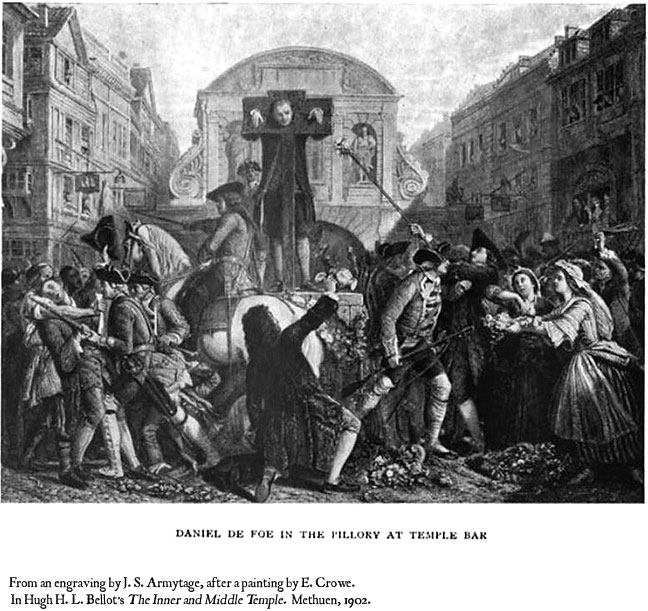
his tail." He was condemned by the authorities to stand in the
pillory at Temple Bar, and imprisoned for nearly two years in Newgate.
But misfortune and imprisonment were powerless to tame his indomitable spirit
or check his restless energy. He kept up the fight within the walls of his
prison, writing controversial pamphlets, and starting a new periodical, his
famous Review. If we needed any proof of that vigour, courage, and
versatility for which Defoe is distinguished, any demonstration of his almost
unequalled readiness and fluency as a writer, we could find it in the pages of
this periodical alone. In his Review, Defoe aimed to set forth and discuss
the current news not of
After Defoe was released from prison in 1704, his course became less open and
straightforward. He was employed on sundry secret missions by the government,
sometimes, he tells us, "running as much risk as a grenadier on a
counterscarp." The dependence of the author upon the politician, which has
been always referred to, had its temptations and its drawbacks as well as its
advantages. It was a time of political uncertainty and of rapid change. Now the
Whigs were in power, now the Tories; and the struggling author whose very
livelihood was largely dependent upon the favour of the party in power had
strong, if selfish, reasons for transferring his services to the winning side.
Defoe had shown that he could be bold in the defence of an unpopular cause; but
he was a master of the art of deception, and his character seems to have been a
singular mixture of courage and duplicity. When the Whigs were in control, he
served the Whigs, and when the Tories took their place, the Tories; and in
doing this he stooped in one instance to a deception which it is certainly hard
to defence.
Yet it would be a great mistake to think of him as habitually willing to
sacrifice his principles to his personal advantage; nothing could be farther
from the truth.
Such was the general character of the first sixty years of Defoe's life, years
of change, struggle, and almost incredible toil. Up to this time he had made no
great and permanent contribution to his country's literature. He had written
much, and he had profoundly influenced the men of his own time; but a great
part of his writings had been devoted to questions of the hour, and intended
only to serve some present need. All his toil seemed to have brought him but
little. Many regarded him with suspicion or contempt; he was a hanger-on of
politicians, excluded from the select coterie of great writers, and a mark for
the shafts of Addison and Swift; yet, at sixty, this journalist and political
agent of questionable character published Robinson Crusoe (1719), a
story which promises to delight the world so long ans
the spirit of manly adventure and the love of the marvellous survive in the
heart of man. It may seem strange to us that such a man should be able to turn
aside at sixty from the tangles and turmoils of
political disputes, and, by sheer force of imagination, to put himself in the
place of a poor sailor, cast away on a solitary island in the Caribbean Sea;
but, in reality, some of Defoe's past work had, all unknown to him, been a
preparation for his great task. Even in his Shortest Way with Dissenters,
he had shown his ability to assume, for the time, another man's point of view;
and in his work as a purveyor of news he had cultivated that power which he
naturally possessed in so large a measure,—the power of making fiction look
like truth. He had the instinct of the journalist rather than the spirit of the
old-time scholar; the quick perception of what was likely to interest and amuse
his readers, and an adroitness which enabled him to turn any passing sensation
to good account. He was expert in making a "good story," as a modern
newspaper reporter would call it, out of an especially destructive storm, an
earthquake, or the dying confession of a famous criminal; and in these stories
truth and invention were sometimes so cunningly mingled that they became
inseparable.
Now,
Robinson Crusoe is but a reporter's "story" in a more expanded
and a more purely imaginative form. It has a basis of fact, for it was founded
on the adventures of Alexander Selkirk, an English sailor, who, in 1704, was
abandoned by his companions on the
The success of Robinson Crusoe diverted Defoe's energies into a new
channel, and he wrote a number of other stories which make his later years the
most brilliant literary period of his life. Among these "secondary
novels," as Lamb called them, The Memories of a Cavalier, The Life of Captain Singleton, Moll
Among these works of Defoe's last years, The Journal of the Plague Year
(1722) holds a place by itself. It is probably the most wonderful example of
Defoe's power of mingling fact and invention, and of imparting to the whole the
appearance of simple truth. It is a minute, and apparently exact and careful
account of the Great Plague which desolated
When he published Robinson Crusoe, Defoe was in easy circumstances; but
towards the close of his life he became again involved in difficulties, and
even his stron and brave spirit was at last shaken by
repeated misfortunes. Beset by poverty and troubles, he writes the year before
his death: "I am so near my journey's end, and am hastening to the place
where the weary are at rest; be it that the passage is rough and the day
stormy, by what way soever He please to bring me to
the end of it, I desire to finish life with this temper of soul in all cases — Te
Deum Laudamus." His magnificent
vitality which had brought him through so much now at last broke, and he
"died of a lethargy" in a
1 According
to Defoe's estimate, eighty thousand copies of this poem were sold in the
streets.
2 "This [the Review] was his largest, if not his most
important, work, embracing in over five thousand pages essays on almost every
branch of human knowledge; during the same nine years he published eighty
distinct works, with 4,727 pages." Chambers's Cyclopedia
of English Literature (new editions), vol. ii, p.150.
Site copyright ©1996-2007 Anniina
Jokinen. All Rights Reserved.
Created by Anniina Jokinen on October 5, 2006. Last update May 6, 2007.
http://www.luminarium.org/eightlit/defoe/defoebio.htm