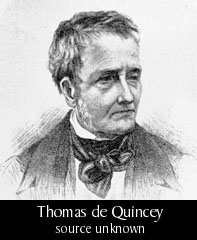
by Thomas DeQuincey

Introduction to the Pains of Opium.
Courteous, and, I hope, indulgent reader (for all my readers must be indulgent
ones, or else, I fear, I shall shock them too much to count on their courtesy),
having accompanied me thus far, now let me request you to move onwards,
for about eight years; that is to say, from 1804 (when I said that my acquaintance
with opium first began) to 1812. The years of academic life are now over
and gone, -- almost forgotten; the student's cap no longer presses my temples;
if my cap exists at all, it presses those of some youthful scholar, I trust,
as happy as myself, and as passionate a lover of knowledge. My gown is,
by this time, I dare to say, in the same condition with many thousands
of excellent books in the Bodleian, namely, diligently perused by certain
studious moths and worms; or departed, however (which is all that I know
of its fate), to that great reservoir of somewhere, to which all
the tea-cups, tea-caddies, tea-pots, tea-kettles, etc., have departed,
not to speak of still frailer vessels, such as glasses, decanters, bed-makers,
etc.), which occasional resemblances in the present generation of tea-cups,
etc., remind me of having once possessed, but of whose departure and final
fate, I, in common with most gownsmen of either university, could give,
I suspect, but an obscure and conjectural history. The persecutions of
the chapel-bell, sounding its unwelcome summons to six o'clock matins,
interrupt my slumbers no longer; the porter who rang it, upon whose beautiful
nose (bronze, inlaid with copper) I wrote, in retaliation, so many Greek
epigrams whilst I was dressing, is dead, and has ceased to disturb anybody;
and I, and many others who suffered much from his tintinnabulous propensities,
have now agreed to overlook his errors, and have forgiven him. Even with
the bell I am now in charity; it rings, I suppose, as formerly, thrice
a day; and cruelly annoys, I doubt not, many worthy gentlemen, and disturbs
their peace of mind; but, as to me, in this year 1812, I regard its treacherous
voice no longer (treacherous I call it, for, by some refinement of malice,
it spoke in as sweet and silvery tones as if it had been inviting one to
a party); its tones have no longer, indeed, power to reach me let the wind
sit as favourable as the malice of the bell itself could wish; for I am
two hundred and fifty miles away from it, and buried in the depth of mountains.
And what am I doing amongst the mountains? Taking opium. Yes, but what
else? Why, reader, in 1812, the year we are now arrived at, as well as
for some years previous, I have been chiefly studying German metaphysics,
in the writings of Kant, Fichte, Schelling, etc. And how, and in what manner,
do I live? in short, what class or description of men do I belong to? I
am at this period, namely, in 1812, living in a cottage; and with a single
female servant (honi soit qui mal y pense), who, amongst my neighbours,
passes by the name of my "house-keeper." And, as a scholar and a man of
learned education, and in that sense a gentleman, I may presume to class
myself as an unworthy member of that indefinite body called gentlemen.
Partly on the ground I have assigned, perhaps, -- partly because, from
my having no visible calling or business, it is rightly judged that I must
be living on my private fortune, -- I am so classed by my neighbours; and,
by the courtesy of modern England, I am usually addressed on letters, etc.,
Esquire, though having, I fear, in the rigorous construction of
heralds, but slender pretensions to that distinguished honour; -- yes,
in popular estimation, I am X. Y. Z., Esquire, but not Justice of the Peace,
nor Custos Rotulorum. Am I married? Not yet. And I still take opium. On
Saturday nights. And, perhaps, have taken it unblushingly ever since "the
rainy Sunday," and "the stately Pantheon," and "the beatific druggist"
of 1804? Even so. And how do I find my health after all this opium-eating?
in short, how do I do? Why, pretty well, I thank you, reader; in the phrase
of ladies in the straw, "as well as can be expected." In fact, if I dared
to say the real and simple truth (it must not be forgotten that hitherto
I thought, to satisfy the theories of medical men, I ought to be ill),
I was never better in my life than in the spring of 1812; and I hope sincerely,
that the quantity of claret, port, or "particular Madeira," which, in all
probability, you, good reader, have taken and design to take, for every
term of eight years, during your natural life, may as little disorder your
health as mine was disordered by opium I had taken for the eight years
between 1804 and 1812. Hence you may see again the danger of taking any
medical advice from "Anastasius;" in divinity, for aught I know, or law,
he may be a safe counsellor, but not in medicine. No; it is far better
to consult Dr. Buchan, as I did; for I never forgot that worthy man's excellent
suggestion, and I was "particularly careful not to take above five-and-twenty
ounces of laudanum." To this moderation and temperate use of the article
I may ascribe it, I suppose, that as yet, at least (that is, in 1812),
I am ignorant and unsuspicious of the avenging terrors which opium has
in store for those who abuse its lenity. At the same time, I have only
been a dilettante eater of opium; eight years' practice, even with
the single precaution of allowing sufficient intervals between every indulgence,
has not been sufficient to make opium necessary to me as an article of
daily diet. But now comes a different era. Move on, if you please, reader,
to 1813. In the summer of the year we have just quitted, I had suffered
much in bodily health from distress of mind connected with a very melancholy
event. This event, being no ways related to the subject now before me,
further than through bodily illness which it produced, I need not more
particularly notice. Whether this illness of 1812 had any share in that
of 1813, I know not; but so it was, that, in the latter year, I was attacked
by a most appalling irritation of the stomach, in all respects the same
as that which had caused me so much suffering in youth, and accompanied
by a revival of all the old dreams. This is the point of my narrative on
which, as respects my own self-justification, the whole of what follows
may be said to hinge. And here I find myself in a perplexing dilemma: --
Either, on the one hand, I must exhaust the reader's patience, by such
a detail of my malady, and of my struggles with it, as might suffice to
establish the fact of my inability to wrestle any longer with irritation
and constant suffering; or, on the other hand, by passing lightly over
this critical part of my story, I must forego the benefit of a stronger
impression left on the mind of the reader, and must lay myself open to
the misconstruction of having slipped by the easy and gradual steps of
self-indulging persons, from the first to the final stage of opium-eating
(a misconstruction to which there will be a lurking predisposition in most
readers, from my previous acknowledgment). This is the dilemma, the first
horn of which would be sufficient to toss and gore any column of patient
readers, though drawn up sixteen deep, and constantly relieved by fresh
men; consequently that is not to be thought of. It remains, then,
that I postulate so much as is necessary for my purpose. And let
me take as full credit for what I postulate as if I had demonstrated it,
good reader, at the expense of your patience and my own. Be not so ungenerous
as to let me suffer in your good opinion through my own forbearance and
regard for your comfort. No; believe all that I ask of you, namely, that
I could resist no longer, -- believe it liberally, and as an act of grace,
or else in mere prudence; for, if not, then, in the next edition of my
Opium Confessions, revised and enlarged, I will make you believe, and tremble;
and, à force d'ennuyer, by mere dint of pandiculation, I
will terrify all readers of mine from ever again questioning any postulate
that I shall think fit to make.
This, then, let me repeat: I postulate that at the time I began to take
opium daily, I could not have done otherwise. Whether, indeed, afterwards,
I might not have succeeded in breaking off the habit, even when it seemed
to me that all efforts would be unavailing, and whether many of the innumerable
efforts which I did make might not have been carried much further, and
my gradual re-conquests of ground lost migbt not have been followed up
much more energetically, -- these are questions which I must decline. Perhaps
I might make out a case of palliation; but -- shall I speak ingenuously?
-- I confess it, as a besetting infirmity of mine, that I am too much of
an Eudæmonist; I hanker too much after a state of happiness, both
for myself and others; I cannot face misery, whether my own or not, with
an eye of sue, that no old gentleman, "with a snow-white beard," will have
any chance of persuading me to surrender "the little golden receptacle
of the pernicious drug." No; I give notice to all, whether moralists or
surgeons, that whatever be their pretensions and skill in their respective
lines of practice, they must not hope for any countenance from me, if they
think to begin by any savage proposition for a Lent or Ramadam of abstinence
from opium. This, then, being all fully understood between us, we shall
in future sail before the wind. Now, then, reader, from 1813 where all
this time we have been sitting down and loitering, rise up, if you please,
and walk forward about three years more. Now draw up the curtain, and you
shall see me in a new character.
If any man, poor or rich, were to say that he would tell us what had
been the happiest day in his life, and the why and the wherefore, I suppose
that we should all cry out, Hear him! hear him! As to the happiest day,
that must be very difficult for any wise man to name; because any event,
that could occupy so distinguished a place in a man's retrospect of his
life, or be entitled to have shed a special felicity on any one day, ought
to be of such an enduring character, as that (accidents apart) it should
have continued to shed the same felicity, or one not distinguishably less,
on many years together. To the happiest lustrum, however, or even
to the happiest year, it may be allowed to any man to point without
discountenance from wisdom. This year, in my case, reader, was the one
which we have now reached; though it stood, I confess, as a parenthesis
between years of a gloomier character. It was a year of brilliant water
(to speak after the manner of jewellers), set, as it were, and insulated,
in the gloom and cloudy melanchaly of opium. Strange as it may sound, I
had a little before this time descended suddenly, and without any considerable
effort, from three hundred and twenty grains of opium (that is, eight[2]
thousand drops of laudanum) per day, to forty grains, or one-eighth part.
Instantaneously, and as if by magic, the cloud of profoundest melancholy
which rested upon my brain, like some black vapours that I have seen roll
away from the summits of mountains, drew off in one day; passed off with
its murky banners as simultaneously as a ship that has been stranded, and
is floated off by a spring tide, --
That moveth altogether, if it move at all.
Now, then, I was again happy: I now took only one thousand drops of laudanum
per day, -- and what was that? A later spring had come to close up the
season of youth; my brain performed its functions as healthily as ever
before. I read Kant again, and again I understood him, or fancied that
I did. Again my feelings of pleasure expanded themselves to all around
me; and if any man from Oxford or Cama way that none of the statuesque
attitudes exhibited in the ballets in the opera-house, though so ostentatiously
complex, had ever done. In a cottage kitchen, but panelled on the wall
with dark wood, that from age and rubbing resembled oak, and looking more
like a rustic hall of entrance than a kitchen, stood the Malay, his turban
and loose trousers of dingy white relieved upon the dark panelling; he
had placed himself nearer to the girl than she seemed to relish, though
her native spirit of mountain intrepidity contended with the feeling of
simple awe which her countenance expressed, as she gazed upon the tiger-cat
before her. And a more striking picture there could not be imagined, than
the beautiful English face of the girl, and its exquisite fairness, together
with her erect and independent attitude, contrasted with the sallow and
bilious skin of the Malay, enamelled or veneered with mahogany by marine
air, his small, fierce, restless eyes, thin lips, slavish gestures, and
adorations. Half hidden by the ferocious-looking Malay, was a little child
from a neighbouring cottage, who had crept in after him, and was now in
the act of reverting its head and gazing upwards at the turban and the
fiery eyes beneath it, whilst with one hand he caught at the dress of the
young woman for protection.
My knowledge of the Oriental tongues is not remarkably extensive, being,
indeed, confined to two words, -- the Arabic word for barley, and the Turkish
for opium (madjoon), which I have learnt from "Anastasius." And, as I had
neither a Malay dictionary, nor even Adelung's "Mithridates," which might
have helped me to a few words, I addressed him in some lines from the "Iliad";
considering that, of such language as I possessed, the Greek, in point
of longitude, came geographically nearest to an Oriental one. He worshipped
me in a devout manner, and replied in what I suppose was Malay. In this
way I saved my reputation with my neighbours; for the Malay had no means
of betraying the secret. He lay down upon the floor for about an hour,
and then pursued his journey. On his departure, I presented him with a
piece of opium. To him, as an Orientalist, I concluded that opium must
be familiar. and the expression of his face convinced me that it was. Nevertheless,
I was struck with some little consternation when I saw him suddenly raise
his hand to his mouth, and (in the school-boy phrase) bolt the whole, divided
into three pieces, at one mouthful. The quantity was enough to kill three
dragoons and their horses, and I felt some alarm for the poor creature;
but what could be done? I had given him the opium in compassion for his
solitary life, on recollecting that, if he had travelled on foot from London,
it must be nearly three weeks since he could have exchanged a thought with
any human being. I could not think of violating the laws of hospitality
by having him seized and drenched with an emetic, and thus frl creations,
I cannot fail, in that way, to be a gainer. And now, reader, we have run
through all the categories of my condition, as it stood about 1816-1817,
up to the middle of which latter year I judge myself to have been a happy
man; and the elements of that happiness I have endeavoured to place before
you, in the above sketch of the interior of a scholar's library, -- in
a cottage among the mountains, on a stormy winter evening.
But now farewell, a long farewell, to happiness, winter or summer! farewell
to smiles and laughter! farewell to peace of mind! farewell to hope and
to tranquil dreams, and to the blessed consolations of sleep! For more
than three years and a half I am summoned away from these; I am now arrived
at an Iliad of woes: for I have now to record --
The Pains of Opium

Footnotes:
-
1.A
handsome news-room, of which I was very politely made free in passing through
Manchester, by several gentlemen of that place, is called, I think, The
Porch; whence I, who am a stranger in Manchester, inferred that the
subscribers meant to profess themselves followers of Zeno. But I have been
since assured that this is a mistake.
-
2.
I here reckon twenty-five drops of laudanum as equivalent to one grain
of opium, which, I believe, is the common estimate. However, as both may
be considered variable quantities (the crude opium varying much in strength,
and the tincture still more), I suppose that no infinitesimal accuracy
can be had in such a calculation. Tea-spoons vary as much in size as oplum
in strength. Small ones hold about one hundred drops: so that eight thousand
drops are about eighty times a tea-spoonful. The reader sees how much I
kept within Dr. Buchan's indulgent allowance.
-
3.
This, however, is not a necessary conclusion, the varieties of effect produced
by opium on different constitutions are infinite. A London magistrate (Harriott's
"Struggles through Life," vol. iii., p. 391, third edition) has recorded
that on the first occasion of his trying laudanum for the gout, he took
FORTY drops; the next night SIXTY, and on the fifth night EIGHTY, without
any effect whatever; and this at an advanced age. I have an anecdote from
a country surgeon, however, which sinks Mr. Harriott's case into a trifle,
and in my projected medical treatise on opium, which I will publish, provided
the College of Surgeons will pay me for enlightening their benighted understandings
upon this subject, I will relate it; but it is far too good a story to
be published gratis.
-
4.
See the common accounts, in any Eastern traveller or voyager, of the frantic
excesses committed by Malays who have taken opium, or are reduced to desperation
by ill-luck at gambling.
CONTINUE