
Antonio Soriano Vidal.
Grupo: A
Poesía Inglesa de los Siglos XIX y XX.
Index:
1-
Introduction
2-
Abstract
2.1- Elizabeth Barret Browning
2.2- Robert Browning
3- Personal opinion
4- References
1- Introduction:
In
this paper I’m going to compare two of the greatest authors of the Victorian
era Elizabeth Barret Browning and her husband Robert Browning.
Elizabeth Barret Browning (March 6, 1806 – June 29, 1861) was one of the most respected poets of the Victorian era.
Mrs. Browning was a woman of
singular nobility and charm. Mary Russell
Mitford
described her as a young woman: "A slight, delicate figure, with a shower
of dark curls falling on each side of a most expressive face; large, tender
eyes, richly fringed by dark eyelashes, and a smile like a sunbeam." Anne Thackeray Ritchie described her as: "Very small
and brown" with big, exotic eyes and an overgenerous mouth.
Barrett Browning is generally
considered one of the great English poets. Her works address a wide range of
issues and ideas. Her own sufferings, combined with her moral and intellectual
strength, made her the champion of the suffering and oppressed. Her gift was
essentially lyrical, though much of her work was not so in form. Her weak
points are the lack of compression, an occasional somewhat obtrusive mannerism,
and experimentation both in metre and rhyme.
Her most famous work is Sonnets from
the Portuguese,
a collection of love sonnets.
Her Petrarcan Sonnets from the
Portuguese are exquisite; she was also a prophetic, indeed epic, poet, writing
Casa Guidi Windows in support of
By the other side but in the same
way it is Robert Browning (May 7, 1812–December 12, 1889) was a British poet and playwright whose mastery of dramatic verse, especially dramatic monologues, made him one of the foremost Victorian poets. Robert's father amassed a
library of around 6,000 books, many of them obscure and arcane. Thus, Robert
was raised in a household of significant literary resources. In childhood, he was distinguished
by love of poetry and natural history. By twelve, he had written a book of poetry,
which he destroyed when no publisher could be found. After being at one or two
private schools, and showing an insuperable dislike of school life, he was
educated by a tutor.
Browning was a rapid learner and by
the age of fourteen was fluent in French, Greek, Italian and Latin as well as his native English. He became a great admirer of the Romantic poets, especially Shelley. Following the precedent of
Shelley, Browning became an atheist and vegetarian, both of which he later shed.
Through his mother he inherited musical talent and he composed arrangements of
various songs.
In 1845, Browning met Elizabeth
Barrett leading to their secret marriage in 1846. (The marriage was initially
secret because
Browning's poetry was known to the
cognoscenti from fairly early on in his life, but he remained relatively
obscure as a poet till his middle age. (In the middle of the century, Tennyson was much better known.) After his wife's
death, in 1861, he returned to
The Browning Society was formed for
the appreciation of his works in 1881.
In 1887, Browning produced the major
work of his later years, Parleyings with Certain People of Importance in Their
Day. It
finally presented the poet speaking in his own voice, engaging in a series of
dialogues with long-forgotten figures of literary, artistic, and philosophic history. Once more, the Victorian public was baffled by this, and Browning
returned to the short, concise lyric for his last volume, Asolando.
Browning’s fame today rests mainly
on his dramatic monologues, in which the words not only convey setting and
action but also reveal the speaker’s character. Unlike a soliloquy, the meaning
in a Browning dramatic monologue is not what the speaker directly reveals but
what he inadvertently "gives away" about himself in the process of r.
Browning chooses some of the most debased, extreme and even criminally
psychotic characters rationalizing past actions, or
"special-pleading" his case to a silent auditor in the poem. Duke of
"My Last Duchess," perhaps the most frequently cited example of the
poet's dramatic monologue form. In other monologues, such as "Fra Lippo
Lippi," Browning takes an ostensibly unsavoury or immoral character and
challenges us to discover the goodness, or life-affirming qualities, that often
put the speaker's contemporaneous judges to shame. Ironically, Browning’s
style, which seemed modern and experimental to Victorian readers, owes much to
his love of the seventeenth century poems of John Donne with their abrupt
openings, colloquial phrasing and irregular rhythms. Browning essentially
endorses such a position because he sees an immanent deity that, far from
remaining in a transcendent heaven, is indivisible from temporal process,
assuring that in the fullness of theological time there is ample cause for
celebrating life. Browning's is assuredly at once the most incarnate and
dynamic of deities, in Christianity and perhaps in any of the world's great
religions.
Browning was the first person to
ever have his voice heard after his death. On a recording made by Thomas Edison in 1889, Browning reads "How
They Brought the Good News from
2- Abstract:
Later
of explain a little bit about the two authors that I’m going to based on to
produce my paper, I’m going to compare them using the next topic “The role of
the women in the Victorian era”.
The Victorian era seems like another
world to us. For much of this century the term Victorian, which literally describes things and events (roughly)
in the reign of Queen
Victorian England was a deeply
religious country. A great number of people were habitual church-goers, at
least once and probably twice, every Sunday. The Bible was frequently and
widely read by people of every class; so too were religious stories and
allegories. Yet towards the end of Queen
Education in nineteenth-century
A lady's education was taken, almost
entirely, at home. There were boarding schools, but no University, and the
studies were very different. She learned French, drawing, dancing, music, and
the use of globes. If the school, or the governess, was interested in teaching
any practical skills, she learned plain sewing as well as embroidery, and
accounts.
The one thing that was different was
the place of women in society. There were of course perceptive women of
independent original thought, but for the huge majority life was easier if they
accepted that a woman's place was in the home. To lump all women of the
Victorian era as one body would be wrong.
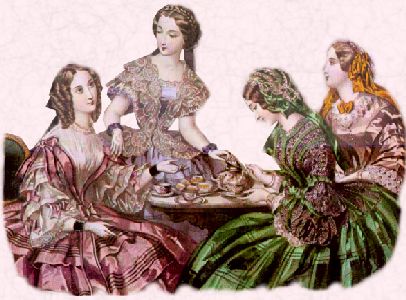
The accepted reasoning
was that the career for women was marriage. To get ready for
courtship and marriage a girl was groomed like a racehorse. In addition
to being able to sing, play an instrument and speak a little French or Italian,
the qualities a young Victorian gentlewoman needed, were to be innocent,
virtuous, biddable, dutiful and be ignorant of intellectual opinion.
A woman's prime use was
to bear a large family and maintain a smooth family atmosphere where a man need
not bother himself about domestic matters. He assumed his house would run
smoothly so he could get on with making money.
Whether married or
single all Victorian women were expected to be weak and helpless, a fragile
delicate flower incapable of making decisions beyond selecting the menu and
ensuring her many children were taught moral values. A gentlewoman
ensured that the home was a place of comfort for her husband and family from
the stresses of Industrial Britain.
Whether or not you agree
with the facts today, the attitude of men toward women in the Victorian age was
highlighted by Tennyson who wrote of women staying by the hearth with their
needles whilst men wielded their swords.
Until late in the
century in
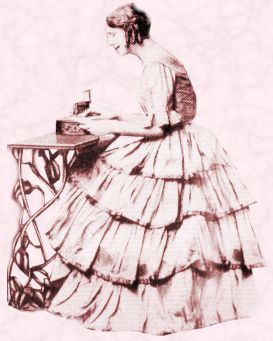
A wealthy wife was supposed to spend
her time reading, sewing, receiving guests, going visiting, letter writing,
seeing to the servants and dressing for the part as her husband's social
representative. For the very poor of
2.1-
Elizabeth Barret Browning:
From one hand
it’s the position of Elizabeth Barrett Browning. Aurora Leigh
(1856) is
an epic/novel poem by Elizabeth Barrett Browning and the name of
its heroine. The poem is written in blank verse and encompasses nine books (the
woman's number, the number of the prophetic books of the Sibyl). It is a first
person narration, from the point of view of Aurora, who is modeled on Elizabeth
Barret Browning's dead friend, Margaret
Fuller, while its other heroine, Marian Erle, is an abused
self-taught gypsy who resembles EBB with long spaniel curls. EBB sets the poem
in
In "Gender Construction and the
Kunstlerroman: David
Copperfield and Aurora
Leigh," Gail Turley Houston discusses the conflict of a
woman poet: "
Relegated to the private sphere, the angel of the house was expected to
purge the taints of the male's own daily prostitution of himself in the public
sphere; at the same time, she was also expected to act as the very reward that
made such prostitution possible. Thus to the Victorians the distinctions
between the prostitute and the wife was very tenuous, for the prostitute just
made money doing what Victorian angels/queens were expected to do without pay:
that is, to fulfill and reflect the desires of their procurers without
expressing any desires of their own. (225)
Barbara Charles worth Gelpi
addresses this dichotomy between the woman and the poet in Aurora Leigh, where
·Barrett Browning,
·David, Deirdre." 'Art's a
Service': Social Wound, Sexual Politics, and Aurora Leigh." Browning Institute Studies .13.
(1985): 113-36.
·Gelpi, Barbara Charlesworth.
"Aurora Leigh: The Vocation of the Woman Poet." Victorian Poetry 19. (1981):
35-48.
·Houston, Gail Turley. "Gender
Construstion and Kunstlerroman: David Copperfield and Aurora Leigh." Philological Quarterly 72.
(1993): 213-36.
http://www.victorianweb.org/authors/ebb/bv6.html
In an essay on Elizabeth Barrett
Browning's novel in verse, Aurora
Leigh, Virginia Wolff relays an account by Barrett Browning
concerning her limitations as an artist. Within the body of this lament, the
Victorian poet emphasizes how her disengagement from society hampered her
growth and success as a poet:
Before this seclusion of my illness, I was secluded still, and there are
few of the youngest women in the world who have not seen more, heard more,
known more, of society, than I, who am scarcely to be called young now . . .
Human nature, that my brothers and sisters of the earth were names to me, that
I had beheld no great mountain or river, nothing in fact . . . And do you also
know what a disadvantage this ignorance is to my art? Why, if I live on and yet
do not escape from this seclusion, do you not perceive that I labour under
signal disadvantages — that I am, in a manner as a blind poet? [p. 442]
Barrett Browning's insecurities
concerning her ability to capture humanity without direct reference to human
experience is reflected in the musings of her literary heroine, Aurora Leigh.
Leigh both extols the ability of authors to depict the concrete reality of the
present historical era, while simultaneously placing the art of the poet in the
realm of the ethereal. The author seems almost contradictory when describing
both the purpose and the worth of literary artists. For Barrett Browning
manages to stress the necessity of grounding art in the sphere of the
"Here and Now", as Graham Swift writes, while also purporting that it is the
spiritual, rather than the material or formulaic, nature of poetry that truly
epitomizes "living art" (150).
Immediately after Romney's wedding
to Marian Erle fails tragically to unfold in Book Four, Barrett Browning
launches Book Five with
Every age,
though being beheld too close, is ill-discerned
by those who have not lived past it . . .
But poets
should
Exert a double vision; should have eyes
To see near things as comprehensively
As if afar they took their point of sight,
And distant things as intimately deep
As if they touched them. Let us strive for this.
I do distrust the poet who discerns
No character or glory in his times,
And trundles back his soul five hundred years,
Past moat and drawbridge, into a castle-court,
To sing-oh, not of lizard or of toad
Alive I' the ditch there, — 'twere excusable,
But of some black chief, half-knight, half sheep-lifter,
Some beauteous dame, half chattel and half queen,
As dead as dead must be, for the greater part,
The poems made on their chivalric bones;
And that's no wonder; death inherits death.
Nay, if there's room for poets in this world
A little overgrown, (I think there is)
their sole work is to represent the age,
their age, not Charlemagne's — this live, throbbing age. [Lines 167-203, pp.
148-49]
But soon after declaring the wisdom
of capturing the present or the material reality of society in poetic lines,
Aurora continues her discourse by emphasizing the virtues of poetry inspired by
the spirit, rather than by the "external".
Never
flinch,
But still, unscrupulously epic, catch
upon the burning lava of a song
the full-veined, heaving, double-breasted Age:
May touch the impress with reverent hand, and say
"Behold, — behold the paps we all have sucked!
This bosom seems to beat still, or at least
it sets our beating: this is living art,
which thus presents and thus records true life."
What form
is best for poems? Let me think
of forms less, and the external. Trust the spirit,
As Sovran nature does, to make the form;
for otherwise we only imprison spirit
and not embody. Inward evermore
to outward, — so in life, and so in art
which still is life. [Lines 213-29, p. 150]
·Browning, Elizabeth Barrett. Aurora Leigh.
·
http://www.victorianweb.org/authors/ebb/vanbrunt7.html
Barrett Browning's poem employs a
contemporary setting and contemporary social issues as a context for an inquiry
into the relation between gender and genre. The poem, which explores the Woman
Question, as it was called by contemporaries, dramatizes the modern woman's
severe need for mothers — for, that is, nurturing political and literary female
ancestors. In examining the growth and development of a woman poet, Aurora Leigh
shows that women cripple themselves by internalizing patriarchal or andocentric
conceptions of them. When Aurora Leigh first rejects her arrogant beloved, her
rejection does not free her from the grip of interiorized male constructions of
women, for she merely displaces Romney from the centre of power, speaks about
herself with images of male power, and feminizes him. Only when both can break
free from the conceptual structures that oppress them can she fully become the
woman, wife, and poet she wants to be.
In presenting her heroine's path to poetic and personal maturity,
Barrett Browning not only explored the Victorian relation between gender and
genre but she also created a female literary tradition by alluding to her
predecessors. Her work draws upon novels written by women, Charlotte Brontë's Jane Eyre (1847) being one major source: the female
protagonist's status as an orphan, the figure of a cruel aunt, the proposal by
St. John Rivers, and Rochester's blindness all appear in Aurora Leigh.
A second contribution to a female tradition appears in the poem's
continual use of a gynocentric, as opposed to an andocentric, imagery. Barrett
Browning's long narrative poem thus substitutes female, rather than male, types from the Old Testament and even when
describing men uses female figures from myth as the source of analogy. These
analogies and images, which are driven by the poem's most serious concerns,
represent an important imaginative achievement in themselves.
According to Stone, Elizabeth Barrett Browning is "defiantly
indecorous" in her handling of genre rules. "As early as 1845, she
had conceived the work as 'a sort of novel-poem,...running into the midst of
our conventions, & rushing into drawing-rooms & the like 'where angels
fear to tread'; & so, meeting face to face & without mask the Humanity
of the age, & speaking the truth as I conceive of it, out plainly.'(29) As
her term 'novel-poem' implies, Barrett Browning does not merely mingle genres;
she fuses them together to form a new whole. Aurora Leigh combines a verse buildungsroman or spiritual epic like The Prelude, tracing the growth of
a woman poet's mind, with a treatise on poetics (including a survey of poetic
genres) and a heavily plotted novel in the manner of George Sand, Charles Dickens, and Charlotte Bronte — all enlivened by liberal dashes of racy
social satire in the manner of Byron's Don Juan. (115)
Stone further continues that subverting genre subverts gender,
Since Victorians viewed epic,
philosophic, and racy satiric poetry as male domains, but thought the novel
more suited to female writers. Beyond associating the skills of the novelist
with the supposedly female virtues of the heart, Victorians found the writing
of novels by women more acceptable than attempts in the major poetic genres
because, as Gilbert and Gubar observe, novels did not require or display the
knowledge of classical models barred to most women, novelists did not aspire to
be priestly or prophetic figures interpreting God and the world to their
fellows, and the novel was less subjective than the prevalent lyric and
confessional poetic forms and therefore more congruent with the self-effacing
role prescribed for Victorian women. Precisely these feature of the major
poetic modes — the imitation of classical models (above all, the epic),
prophetic aspirations, and confessional subjectivity — are the most prominent
in Aurora
Leigh.
·Marjorie Stone, "Genre Subversion and Gender Inversion: The Princess and Aurora Leigh,"
Victorian Poetry
25: 2 (Summer 1987).
http://www.victorianweb.org/authors/ebb/al2.html
Great changes in the situation of women
took place in the 19th century, especially concerning marriage
laws and the legal status of women. The situation that fathers always received custody
of their children, leaving the mother completely without any rights, slowly
started to change. The Custody of Infants Act in 1839 gave mothers of
unblemished character access to their children in the event of separation
or divorce,
and the Matrimonial Causes Act in 1857 gave women limited
access to divorce. But while the husband only had to prove his wife's adultery,
a woman had to prove her husband had not only committed adultery but also incest, bigamy, cruelty
or desertion.
In 1873
the Custody of Infants Act extended access to children to all women in
the event of separation or divorce. In 1878, after an amendment to the Matrimonial
Causes Act, women could secure a separation on the grounds of cruelty and
claim custody of their children. Magistrates
even authorized protection orders to wives whose husbands have been convicted
of aggravated assault. An important change was caused by an amendment to the Married
Women's Property Act in 1884 that made a woman no longer a 'chattel'
but an independent and separate person. Through the Guardianship of Infants
Act in 1886
women could be made the sole guardian
of their children if their husband died.
2.2- Robert Browning:
From
the other side but in the same way it’s the point of view of Robert Browning. The central problem in Browning's love
poetry is invariably one of communication between the sexes. The intangible
influences which encourage or destroy intimacy between men and women elicit all
his skill in psychological analysis; for love exists in and through human intuitions.
Reference has already been made to the poet's belief that destined lovers
recognize each other on first sight. But these moments of full and perfect
communion are precarious; and, save for the most exceptional cases; the initial
harmony does not survive social pressures or the importunities of individual
temperament. It is rare in Browning's work to find such a poem as By the Fire-Side, in which the lovers
have so come to exist in each other that one of them can say:
When, if I
think but deep enough,
You are wont
to answer, prompt as rhyme;
And you,
too, find without rebuff
Response
your soul seeks many a time
Piercing
its fine flesh-stuff.
Ideal love is for Browning the
consummation of an intuitive process by which the lovers transcend the barriers
of their separate individualities and achieve spiritual union. Whenever this
happens, there results the most exquisite and productive form of communication
possible between human beings. The very possibility of a love like this excites
the heroine of The Flight of the
Duchess to say:
If any two
creatures grew into one,
They would do more than the world has done:
Though each apart were never so weak,
Ye vainly through the world should seek[101/102]
For the knowledge and the might
Which in such union grew their right...
Browning's men and women, then, are
always seeking to pierce the barrier which, in his favourite metaphor,
separates two isolated souls reaching towards each other. The lover of In a Gondola pleads with his mistress:
Do, break
down the partition-wall
'Twixt us; the daylight world beholds
Curtained in dusk and splendid folds!
What's left but--all of me to take?
As one would expect from what has already been said, Browning holds that
undue reliance on the intellect with its ulterior motivations makes for failure
in affairs of the heart. The feminine nature is wiser than the masculine in its
instinctive response to emotional impulse. In a number of poems love is
destroyed through the man's determination to establish his mental superiority
over the woman. This is the theme of Mesmerism, for example, as well as of A Woman's Last Word in which the woman
soliloquizes:
What so false as truth is,
False to thee?
Where the serpent's tooth is
Shun the tree-[102/103]
Since in the poet's thinking
the intellectual faculties are self-corrupting and prone to infection by the
uses of the world, another group of poems, written from the female point of
view, lays blame for the man's infidelity on the temptations held out by
society. Examples in this vein are Any
Wife to Any Husband, and the group of highly sophisticated lyrics, James Lee's Wife. The comparatively early
Cristina departs from the usual
pattern of Browning's love poems after he had come to know Elizabeth Barrett. For here it is the woman who
is found wanting to the moment of recognition when "mine and her souls
rushed together":
Oh, observe! Of course, next moment,
The world's honours, in derision,
Trampled out the light for ever:
Never fear but there's provision
Of the devil's to quench knowledge
Lest we walk the earth in rapture!
--Making those who catch God's secret
Just so much more prize their capture!
Browning's conviction that the passionate
intensity of romantic love is incompatible with conventionalized social
morality leads him to glorify the one at the expense of the other. That
perennial theme, the world well lost for love, is so appealing that Victorian
readers in their sentimentality were apparently willing to overlook its
frequent anti-social corollary in Browning's poetry, where the decision to give
all for love more often than not involves some course of action at variance
with established codes of conduct. Too extreme, perhaps, is the example of Porphyria's Lover where the demented
narrator has committed murder and in this way made the final choice for a
mistress
Too weak, for all her heart's endeavour,
To set its struggling passion free
From pride, and vainer ties dissever,
And give herself to me for ever. [103/104]
The social satire in The Glove
results from a seeming paradox in the lady's behaviour. Her motive for casting
the glove into the lion-pit seems purely capricious; and the reader's first
inclination is to side with King Francis' court in its condemnation of the lady
and approval of De Lorge when he flings the glove back in her face after its
retrieval. On reconsideration, however, we perceive that our initial judgment
was conditioned by a code of etiquette, rather than by any real concern for the
heroine's situation. By trifling with convention in an apparently irresponsible
way, she has shown up the ingrained conventionality of her admirer whose
bravery, like his subsequent rudeness, was displayed not for the lady's sake,
but solely to win popular approval. The dénouement reveals the poet's meaning.
The lady, followed by the youth who alone comprehends her action, departs from
the artificial life of the court, while De Lorge remains to marry a
lady-in-waiting and to see her become the king's mistress, while he is
relegated to the position of glove-bearer.
If, for Browning, true love necessitates total disregard of the ways of
the world, then it follows that self-interest is love's greatest enemy. A long
succession of poems, concerned with individuals for whom the voice of society
drowns out that of passion, dramatizes, on the negative side, the poet's sense
that no worldly gain is ever achieved without spiritual loss. The disillusioned
lover of Dis Aliter Visum; or, Le Byron
de nos Jours recalls in bitterness of heart how he let opportunity slip
through his fingers from cynical disbelief that the good moment could be
prolonged: [106/107]
She might take me as I take her.
Perfect the hour would pass, alas!
Climb high, love high, what matter? Still,
Feet, feelings, must descend the hill:
An hour's perfection can't recur.
Browning's most provocative examination of failure in love as the
penalty of faint-hearted conformity to social conventions occurs in The Statue and the Bust. The duke
first beheld the lady on the day of her wedding to another man, and at once
their souls "rushed together." Neither is restrained by moral
scruples; yet they postpone the consummation of their love. Each is content
with the daily encounter when the duke rides under the window where his beloved
sits like another Lady of Shalott, but more remote from reality in her
too-patient waiting. So the passing of time and the inconsequential demands of
everyday existence imperceptibly dull the edge of resolve, although the lovers
continue to delude themselves with the belief that such steadfastness as theirs
must eventually be rewarded. Meanwhile, it is better not to provoke a scandal:
[107/108]
And still, as love's brief morning wore,
With a gentle start, half smile, half sigh,
They found love not as it seemed before.
They thought it would work infallibly,
But not in despite of heaven and earth:
The rose would blow when the storm passed by.
Meantime they could profit in winter's dearth
By store of fruits that supplant the rose:
The world and its ways have a certain worth:
And to press a point while these oppose
Were a simple policy; better wait:
We lose no friends and we gain no foes.
When it is too late, they awaken to the realization that they have
wasted their lives in make-believe:
And both perceived they had dreamed a dream;
Which hovered as dreams do, still above:
But who can take a dream for a truth?
Oh, hide our eyes from the next remove!
In the end the lovers call in art to eternalize their devotion; but the
statue and the bust mock rather than glorify the impulse which brings them into
being. Fixed in their apartness, they are as futile and as static as the couple
they commemorate. Art has been made a substitute for, not a confirmation of
life. That there might be no mistaking his meaning, Browning attached a coda to
the poem. In Hamlet's phrase, "The readiness is all." Virtue is not
in the goal, but in the passionate intensity of striving:
Do your best, whether winning or losing it,
If you choose to play! -- is my principle.
Let a man contend to the uttermost
For his life's set prize, be it what it will!
The counter our lovers staked was lost
As surely as if it were lawful coin:
And the sin I impute to each frustrate ghost [108/109]
Is -- the unlit lamp and the ungirt loin,
Though the end in sight was a vice, I say.
If we turn now to Browning's aesthetics, it is
immediately apparent from such poems as Youth
and Art and The Statue and the
Bust that for this poet art could never supplant life. No position is
more consistently maintained throughout his writing than the one deriving from
the assumption that all enduring artistic expression is incidental to the
experience which inspires it. Poems otherwise so different as The Last Ride Together, In a Balcony, Cleon,
Old Pictures in Florence, "Transcendentalism: A Poem in Twelve
Books," James Lee's Wife, and One Word More reiterate the author's vitalism. Art exists simply
as one form of creative endeavor to educe life's meaning. The test of an
artist's genius lies in his ability to move his audience to action. The Pied Piper, Fra Lippo Lippi, and the David of Saul have this faculty in common. The
rats and children of
The concept of Victorian
masculinity is a diverse one since it was influenced by numerous aspects
and factors such as religion, domesticity and gender roles,
Imperialism,
economy,
sporting
competition, manners, and much more. Some of these aspects seem to be quite
naturally related to one another, while others seem profoundly none-relational.
The concept of Victorian masculinity is a topic of interest in the context of Cultural
Studies with a special emphasis on Gender
studies. The topic is of much current interest in the areas of sociology,
history,
literary criticism, and religious
studies. Those virtues that survived until today are of special
interest to the researchers: the 'dominance of the Western male'. The concept
itself shifted about the mid of the 19th century
from a focus on a desired achievement of Christian
maturity to a focus on hardiness. With the start of the Industrial Revolution, British culture
experienced a "separation of spheres" into the public
and the private sphere. Also, the Christian religion
was a substantial part of British culture. The time between 1830 and 1860 was,
for the most part, a period of peace, and men did not feel threatened to be
called to a life as soldiers, etc. The result of these historic preconditions
was a concept of masculinity which was clearly defined by domesticity, although this is generally
believed to be a female domain. Naturally, this male domesticity is seen as
being an instance of traditional gender roles and being motivated and governed
by Christian beliefs and values. Christianity contributed much to the Victorian
concept of masculinity. The real Victorian man was to be spiritual and a
faithful believer. The Christian religion defined the status of the man within
his home in terms of patriarchy, as Bible passages prove that were widely read as family prayers.
"Wives, submit yourselves to your own husband, as it is fit in the
Lord.
Husbands love your wives and are not bitter against them.
Children, obey your parents in all things, for this is well onto pleasing the
Lord."
·The Bible (
Early in the 19th century, domesticity was at the core of the concept of
masculinity. Neither did men exclusively consider a wife and children as
necessary components of his masculine status nor did they see their homes as
property only. The home was for the Victorian man the place that satisfied his
deepest needs. It meant a profound attachment in an emotional as well as in a
physical sense. It provided privacy and comfort and it meant separation from
the workplace, which places the concept of home into direct contrast to the
public sphere. But contrary to the wide-spread opinion that the home was merely
a female sphere, Victorian males were indeed active in the private sphere as
well: they operated in both spheres. Like in the private sphere, men of the
Victorian era were equally active in the public sphere (in contrast to women).
Work was crucial in order to achieve a fully masculine status. This was
especially true for the middle-class man; male members of the aristocracy
were seen as idle because they generally did not work. By being active in
enterprise, men fulfilled their duty as breadwinners in the sense that they had
to provide for their family. Since home and work were perceived as very
separate spheres, working at home was a delicate matter, for example for
writers, who had to fear their masculine status being threatened. Besides work,
Victorian men were also active in the public sphere of clubs and taverns,
indulging in homosociality.
In the second half
of the 19th century the ideal of Victorian manliness became increasingly
defined by imperialism because the subordination of
non-western cultures was on its heyday in
3- Personal opinion:
I would like to say that before I have done my paper, I’m suppose to know
all about the role of the women in the Victorian era, and I’m agree with this
affirmation because, after I have done my paper I’m not aware of the capacity
of the women, being in the scratch, to create a project to express their
feelings like the Women’s Writing Project. I’m very surprised and happy with
the capacity of not only the women, the men too, to leave out the bad things of
the society and concentrate in what they like, write. Furthermore, now I’m
aware of all the aspects of the fashion era, that it’s a very interesting thing.
Summarizing, from
my point of view, I’m very happy of having choose that topic because I learnt a
lot about this splendid period and those magnificent writers.
4- References:
· http://en.wikipedia.org/wiki/Robert_Browning
19-12-2007
· http://en.wikipedia.org/wiki/Elizabeth_Barrett_Browning
19-12-2007
· http://victorianweb.org/authors/ebb/index.html
19-12-2007
· http://victorianweb.org/authors/rb/index.html
19-12-2007
· http://www.fashion-era.com/a_womans_place.htm
2- 1-2008 By Pauline Weston Thomas
· http://www.english.uwosh.edu/roth/VictorianEngland.htm
2-1-2008
· http://www.wwnorton.com/college/english/nael/victorian/welcome.htm
2-1-2008
· http://www.victoriaspast.com/FrontPorch/victorianera.htm
2-1-2008 By Ilana Miller