







Commentary
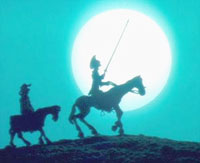
In the novel of Don
Quijote de la Mancha the dialogues between Don
Quijote and Sancho
Panza play a fundamental role. Its main characteristic is their
naturality, their serious tone, the fluent speech and the colloquial
style. It has several functions, one of them being the narrative function
because the dialogues substitute a narrator, another one being characterisation:
with its chivalrous and formal registers Don Quijote represents the
aristocracy and Sancho Panza, with a more colloquial register, the lower
social classes. Through the dialogues we not only learn about their
social class, but we also learn about their personality: Don Quijote
represents the perspective of the ideal knight, the romantic dreamer
that refuses to see the reality, who believes innocently that there
is only right and wrong and that he can make a difference. Sancho is
a down to earth person, realistic and cautious, and at the same time
very comic through his use of popular proverbs. Just like Falstaff,
he accompanies his master through different adventures, always trying
to bring Don Quijote closer to the reality he refuses to see.
Like the characters of Falstaff
and Prince
Harry, they complement each other in their speech: if Don Quijote
masters the more poetical and formal registers, he does often switch
to a more colloquial style when he is trying to explain the world of
chivalry to Sancho, and so does Sancho try to adapt his vulgar, more
colloquial way of speaking with a more elevated style that will show
his politeness towards his master. To show how this works, we will have
a look at Chapter XXXI, of the first part
of the novel.
This is an example of a parody of a chivalrous situation: Sancho Panza
has been sent to hand a letter to Dulcinea del Toboso, where Don Quijote
expresses his love for her, as is the manner in the code of knights,
however nothing turns out to be like the chivalric novels that Don Quijote
has read and he is puzzled by the account Sancho Panza gives when he
returns from his mission.
A proof of Don Quijote idealistic vision of the world can be found in
his use of similes and metaphors: he calls Dulcinea “aquella reina
de la hermosura” (line 2) or “que los granos de aquel trigo
eran granos de perlas, tocados de sus manos”, or “aquella
rosa entre espinas, aquel lirio del campo, aquel ámbar desleído”(line
34-35). He uses a very poetic language every time he refers to his beloved
one, juxtaposed to the reality explained by Sancho. Don Quijote uses
formal language when he tries to imagine what Dulcinea must have been
doing or to explain the ceremony of receiving such a letter according
to the chivalric code, but he also uses quite frequently imperative
verbs such as “prosigue”, “haz”, “pasa”,
“acaba, cuétamelo”, which on the one hand portray
his eagerness to hear Sancho’s account and on the other hand convey
the hierarchical relation master-servant. Don Quijote’s blindness
to see the reality is emphasized by the use of adverbs and verbs of
certainty or probability : “A buen seguro que” (line 2),
“Pues yo te aseguro” (line 8), “sin duda alguna”
(line 8-9), “eso debió ser”(line 14), he claims to
know how Dulcinea reacted to the letter, but what Sancho tells is quite
a different story, and that is why Sancho uses frequently negative sentences
to answer Don Quijote: “No la hallé sino…”
(line 4), “No era sino…” (line 7),“no la leyó”
(line 41), “no sabía leer ni escribir” (line 41).
In the formal language of Don Quijote repetitions are avoided with circumlocutions
like the one in line 15: “Y en tanto que estaba en su menester”.
Cervantes also uses archaic overloaded expressions, such as in line
15: “¿qué coloquios pasó contigo?”.
Don Quijote’s language becomes at some points more poetic through
the use of hyperbaton, like in line 21: “En decir que maldecía
mi fortuna dijiste mal”. When a word has a double meaning, Don
Quijote understands and uses only the metaphorical sense and fails to
understand the literal sense, for example with the word “alta”,
that Sancho uses all the time in a literal sense and that Don Quijote
understands only in a metaphorical sense (lines 23 to 28).
The chivalrous register in Don Quijote’s speech is quite obvious
when he tries to explain the customs in the chivalric code in the novels
he has read: “Porque es usada y antigua costumbre entre los caballeros
y damas andantes dar a los escuderos, doncellas o enanos que les llevan
nuevas, de sus damas a ellos, a ellas de sus andantes, alguna rica joya
en albricias, en agradecimiento de su recado”.(lines 53 to 55)
Sancho’s language represents here the juxtaposition of the chivalric
world with the real one: not only does he use the negative sentences
mentioned before to try to convince Don Quijote that the world of knightly
customs does not correspond to reality but he also does so in a very
comic, naive way. He uses mainly the colloquial register, with common
vocabulary, as opposed to the more prosaic language of Don Quijote:
“ahechando dos anegas de trigo en un corral de su casa”
(line 4), “ella estaba en la fuga del meneo de una buena parte
de trigo que tenía en la criba” (lines 12). As he tells
the story of what happened, he even brings up a topic which is taboo
in the chivalric world, the one of the smell of Dulcinea’s sweat,
and he describes it with plain words: “un olorcillo algo hombruno”,
“estaba sudada y algo correosa” (line 32), juxtaposed to
Don Quijote’s previous poetic suggestions: “un olor sabeo,
una fragancia aromática” (line 29). This dialogue also
contains one of the so called “sanchismos”, one of his proverbs:
“pero no hay de qué maravillarse, que un Diablo parece
a otro” (line 37), diametrically opposed to the initial description
of Dulcinea as “reina de la hermosura” (line 2). The whole
chivalric world that Don Quijote tries to build through his choice of
metaphors, similes, complex sentences, clashes and at the same time
complements itself in the colloquial register of Sancho, who also tries
to show politeness by expressions such as “vuestra merced”
every time he mentions Don Quijote. Sancho includes in his speeches
some elements from an elevated style but fails to do so till the end,
as can be seen in the sentence lines 17to 20: “mas yo le dije
de la manera que vuestra merced, por su servicio, quedaba haciendo penitencia,
desnudo de la cintura arriba, metido en estas tierras como si fuera
salvaje, durmiendo en el suelo, sin comer pan a manteles ni sin peinarse
la barba, llorando y maldiciendo su fortuna”, where the first
part of the sentence corresponds to a more prosaic, elevated style and
the second part becomes again more colloquial.
Therefore what has been observed in this chapter of Don
Quijote de la Mancha is something equivalent to what Shakespeare
does in Henry
IV: a masterly alternation of registers
within a continuum ranging from formal language to colloquial style.
Don Quijote’s elevated poetic speech is at points influenced by
Sancho’s colloquial style and so does Sancho try, not only to
stick to colloquial language but to honour the person he serves by using
some aspects of his master’s language. It is this juxtaposition
of speech styles that creates the fantastic parody of the chivalric
world that only exists in books, not in the 17th century castillian
Spain full of Sanchos.