Main Page
Welcome to my phonology web page
ə
From Wikipedia
The McGurk effect is a perceptual phenomenon which demonstrates an interaction between hearing and vision in speech perception. It suggests that speech perception is multimodal, that is, that it involves information from more than one sensory modality. The McGurk effect is sometimes called the McGurk-MacDonald effect. It was first described in a paper by Harry McGurk and John MacDonald in 1976.
This effect may be experienced when a video of one phoneme's production is dubbed with a sound-recording of a different phoneme being spoken. Often, the perceived phoneme is a third, intermediate phoneme. For example, a visual /ga/ combined with an audio /ba/ is often heard as /da/. Further research has shown that it can exist throughout whole sentences. The effect is very robust; that is, knowledge about it seems to have little effect on one's perception of it. This is different from certain optical illusions, which break down once one 'sees through' them.
Study into the McGurk effect is being used to produce more accurate speech recognition programs by making use of a video camera and lip reading software. It has also been examined in relation to witness testimony; Wareham & Wright's 2005 study showed that inconsistent visual information can change the perception of spoken utterances, suggesting that the McGurk effect may have many influences in everyday perception.
See video: http://www.youtube.com/watch?v=jtsfidRq2tw
Transcription Exercise
There was a section of Andalusians next to us
/ðeə wəz ə ˈsekʃәn əv ændəˈluːsiənz nekst tu ʌs
in the line now. I do not know quite how they got to
ɪn ðə lɑɪn naʊ. aɪ du nɒt nəʊ kwaɪt haʊ ðeɪ gɒt tə
this front. The current explanation was that they
ðɪs frʌnt. ðə ˈkʌrənt ekspləˈneɪʃәn wəz ðət ðeɪ
had run away from Málaga so fast that they had
həd rʌn əˈweɪ frəm ˈmæləgə səʊ fɑːst ðət ðeɪ həd
forgotten to stop at Valencia; but this, of course,
fəˈgɒtәn tə stɒp ət vələnʃiə; bət ðɪs, əv kɔːs,
came from the Catalans, who professed to look down
keɪm frəm ðə ˈkætəlænz, huː prəˈfest tə lʊk daʊn
on the Andalusians as a race of semi-savages.
ɒn ðə ændəˈluːsiənz əz ə reɪs əv semiˈsævɪdʒɪz.
Certainly the Andalusians were very
ˈɜːtәnli ði ændəˈluːsiənz wə ˈveri
ignorant. Few if any of them could read, and they
ˈɪgnərənt. fjuː ɪf ˈeni əv ðəm kʊd riːd ənd ðeɪ
seemed not even to know the one thing that
siːmd nɒt ˈiːvәn tə nəʊ ðə wʌn ðɪŋ ðət
everybody knows in Spain, which political
ˈevribɒdi nəʊz ɪn spein, wɪtʃ pəˈlɪtɪkәl
party they belonged to.
ˈpɑːti ðeɪ bɪˈlɒŋd tuː/
A Poem
I take it you already know of tough and bough
/aɪ teɪk it juː ɔːlˈredi nəʊ ɒv ðəʊ ən baʊ
and cough and dough?
ən kɒf ən dəʊ?
Some may stumble, but not you, on hiccough,
sʌm meɪ ˈstʌmbl, bət nɒt juː, ɒn ˈhɪkɒf,
thorough, slough, and through?
ˈθʌrə, slʌf, ən θruː?
Beware of heard, a dreadful word,
bɪˈweə ɒv hɜːd. ə ˈdredfəl wɜːd,
that looks like beard, but sounds like bird.
ðæt lʊks laɪk bɪəd, bət saʊnds laɪk bɜːd.
And dead, it's said like bed, not bead;
æn ded, ɪts sed laɪk bed, nɒt biːd;
for goodness' sake, don't call it deed!
fə ˈgʊdnəs seɪk, dəʊnt kɔːl ɪt diːd!/
Discover
Learn about University College of London’s department of Phonetics and Linguistics:
The Vocal Tract
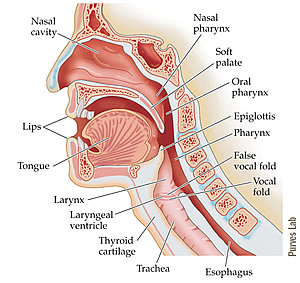
The vocal tract is the cavity in human beings and in animals where sound that is produced at the larynx is filtered. In mammals it consists of the laryngeal cavity, the pharynx, the oral cavity, and the nasal cavity.
Sagittal section of human vocal tract.