Sociological
explanation of the topic.
The
main topic of “Lord of Flies” is the regressive civilisation that the
children experience in the island, several aspects influence this process:
1.
The Previous Education.
It
is transmitted through some cultural rules imposed previously. They are rules of
different expected behaviours according to the different cultures. The education
that these children have received is the Anglo-Saxon, related to a very severe
and repressive society.
For
this reason, the children in the island take a bath for amusement, and not for
hygiene. They do not have an obligation to make it and nobody who commands it.
In the island they are liberated of the repression that they felt when they
washed themselves without feeling dirty or simply necessary. The author speaks
to us of this liberation: “in his other
life, Maurice would have been punished to fill with sand some younger eyes than
his.” However, although nobody quarrels Maurice for what he has made, he
feels regret because he has not followed the behaviour that the society had
imposed him. The education received since he was little was part of his
personality now.
This
also happens to Ralph, and even to Jack to their short age they have not
acquired cruelty, so Jack is not able to kill the boar the first time he has the
opportunity to do it. The following time he will do it because his pride will be
imposed.
The
Anglo-Saxon society is included in the capitalist system, that favours the
competitiveness fundamentally, and consequently the violence. There are violent
confrontations between Ralph and Jack for the power and the authority.
The
education determines what is well and wrong, although they are arbitrary
concepts, and they are always imposed by repressive rules.
In
a first moment they try to adopt a democratic system to be organised, the same
as they have seen the adults, under the control of a boss: Ralph. But Jack is
marked by the competitiveness, he has always been the boss of his choir and he
believes that he should continue being it in the island because he has been
educated for it. For this reason he does not want to relegate his position
neither to Ralph nor anybody, and he forms a separated group in which the
savagery reigns but also the satisfaction, the fear, the pleasure: Jack.
2. Characteristic of the island.
|
|
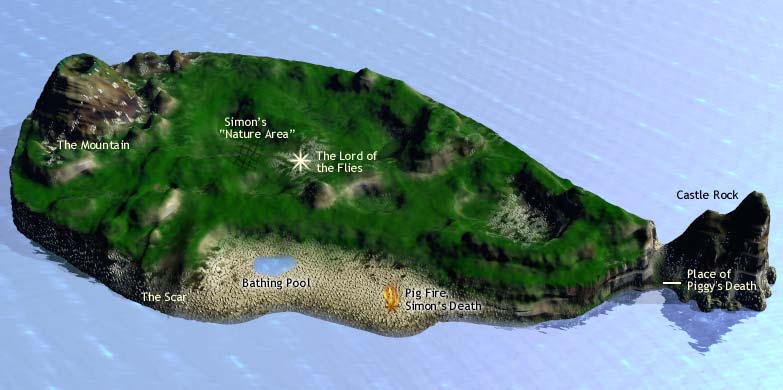
They
are completely favourable for the survival of the children. The tropical weather
of the island provides them wild fruits to satiate their hunger and thirst.
The
personality of all the individuals is modified by the physical environment and
the heat because it does not invite to the work.
Golding
chooses this physical space to develop the work in an island, because he makes
them feel more far from the world of which they proceed, as if they would be
separated of the world without any connection with the previous civilisation and
to be able to develop his main objective: to force the children to be organised.
The
sense of the isolation is such that Jack and the partners that follow him forget
the rescue. They resign to live in the island and they are organised trying to
pass their existence in a better way. Ralph himself forgets in occasions the
sense of his biggest obsession: to maintain the blaze lit. This happens because
he believes that they will never be rescued.
The
wild state makes them forget all education received previously, and Golding
locates the island in an exotic atmosphere so that it contributes to this
regression.
3.
The Anguish.
One
is afraid by concrete things, and is anguished by the abstract ones. The fear
that they feel is genetic and due to the insecurity that they feel. It is
reflected first in the smallest, because they do not have the security that
their parents give them and they lack the stability that the adults provide
them. At the beginning the teenagers do not feel fear toward what is ignored
because Ralph infuses them trust. First they project the anguish the children
feel in nightmares, later they become snakes and finally, when Ralph is unable
to give trust, they fix their anguish in a wild animal that they do not know how
is.
The
fear can disassemble the society or it can live in it. The anguish that they
feel from the beginning breaks down the whole structure that they have risen
with Ralph.
In
the work several forms of controlling the fear are presented:
1.
Simon discovers which is the reason. He knows that we project the anguishes and
with them we deform the reality that is bound to the ignorance, and that the
only way of eliminating is discovering its cause.
2.
Jack buys the fear to the wild animal by offerings. He thinks about the question
of the fear like a hunter and for that reason he offers him the head of the
first boar that they hunt. Jack orders to forget the wild animal. To Jack it
does not interest to discover which is the wild animal because is the base of
his gang.
3. Ralph ignores the existence of the wild animal, although he has seen
it; but this is because his fear prevents him to discover what it is really.
Ralph feels more fear for the people than for the ghosts, it is part of the
human beings.
4.
The man's aggressive nature.
The
aggressiveness is a genetic factor, but when they are made free from the
repression of the culture, it is developed much more and it is often manifested
gradually in the confrontations between Ralph and Jack.
When
they break up with the previous culture they are not able to control their own
aggressiveness and they become insensitive to its consequence: the death.
There
are moments when this aggressiveness becomes in paroxysm: “the desire to attack and to harm was irresistible." The
received culture has repressed Piggy and Ralph more and for that reason they are
not so aggressive as Jack. Now he kills boars with certain regularity and
without any mercy. Piggy’s death does not disturb him.
5.
The Mask.
It
is an object to get away from themselves and an object to be free from what the
society had imposed them.
The
mask liberates them of the shame that they feel when they do irresponsibilities,
damages, etc. Taking a mask that does not allow them to recognise themselves
supposes a new stage in their life. With the masks they are no longer Jack,
Roger, Wilfred. They are wild, different beings that have been released totally
of the culture that the adults began to inculcate them in a more distant time.
They knew very well that the concealing painting covered the wildest acts. They
do not feel shame of their current behaviour because the things have changed.
However Jack wants to break up totally with what the past supposes and for this
reason he also wants to kill Ralph.
The
use of the masks supposes a bench mark of the regression that the children have
experienced. The author no longer calls them for his names, but rather he says:
“a coloured face spoke with Robert's
voice”. It also supposes a bigger adaptation to the environment where they
live, since they will use them to get the camouflage necessary for hunting. The
mask has double utility: to adapt to the rhythm of the animal and to be
liberated of all knot with the past.
6.
The Religion.
The
cult to a wild animal that they fear, and the fact of offering gifts to obtain
its favours supposes the adoption of a primitive religion. Again this is a
factor that accentuates the regression of the culture.
Offering
the head of all animals that they kill is a way of buying the fear instead of
discovering the reason of it.
The dance also serves as an escape, its rhythm: “kill the wild animal! Cut him the neck!” hypnotises them. For these reasons, and the fear that produces them the ferocious storm that watches them, they dance to combat and forget the insecurity they have. The dance makes them go mad as previous times and makes them kill Simon because in this environment of savagery none of them know what they make. They feel like a unique person, and in fact to accentuate this sense of equality, they adopt the form of a circle where everybody is at the same distance of the centre.
The
author's intention.
Golding
reproaches to the society the hard repression that imposes on its individuals
which causes them to break up its measures as soon as they have the opportunity
they are only free from the learned rules as violent instincts that persist in
all the individuals appear.
Golding expresses his opinion about the genetic fear and the desire of power. They are so big that they can be prefixed to the behaviours that they learn during the childhood. But the assimilation in this period is not similar in all the individuals of the society, and for this reason, Golding shows children with better assimilated culture (Ralph, Piggy, Simon) and children that soon break up with that learned culture and adapt to the conditions of the island (Jack).