(2) VP ® Verb + NP
(3) NP ® Det + N
(4) Verb ® Aux +V
(5) Det ® the, a,...
(6) N ® man, ball,...
(7) Aux ® will, can,...
This is a simple phrase-structure grammar. It generates
and thereby defines as grammtical such sentences as "The man will hit the
ball," and it assigns to each sentence that it generates a structural description
The kind of structural description assigned by a phrase-structure granirnar
is, in flict, a constituent structure analysis of the sentence.
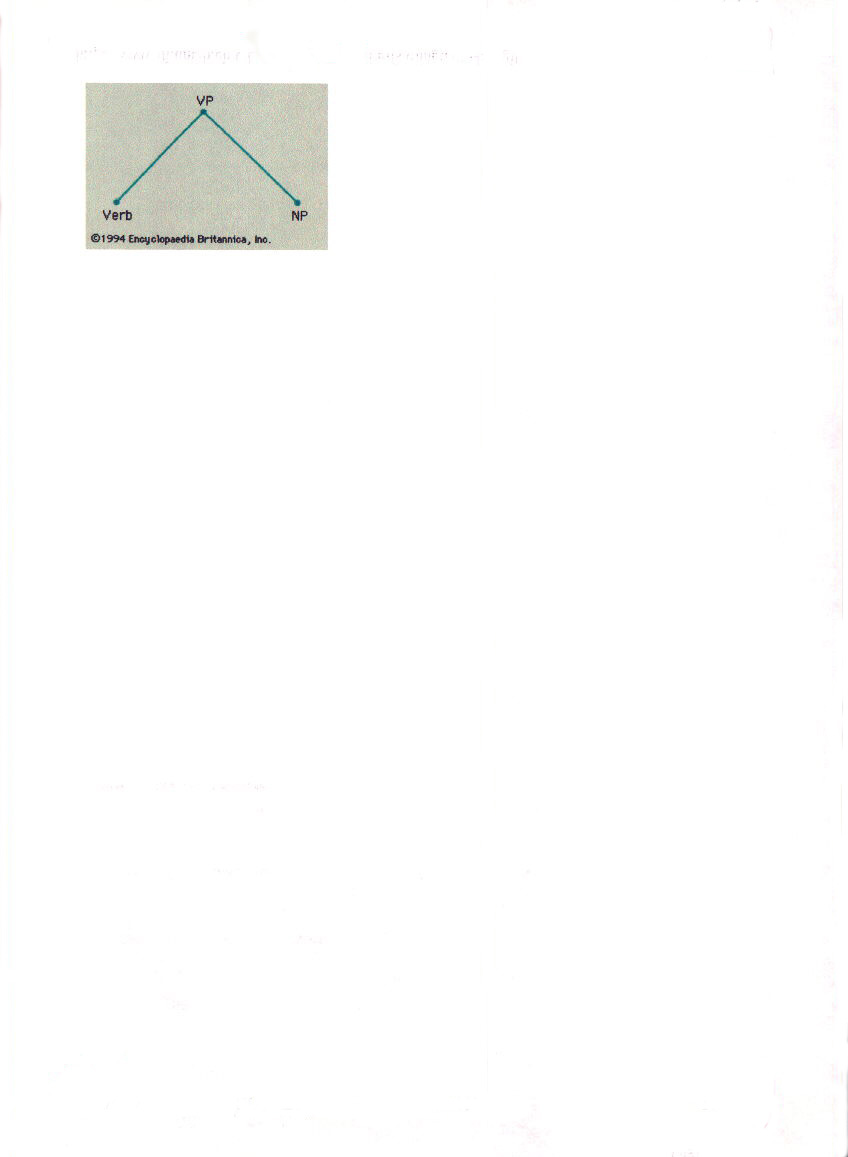
In these rules, the arrow can be interpreted as an instruction to rewrite (this is to be taken as a technical term) whatever symbol appears to the left of the arrow as the symbol or string of symbols that appears to the right of the arrow. For example, rule (2) rewrites the symbol VP as the string of symbols Verb + NP, and it thereby defines Verb + NP to be a construction of the type VP. Or, alternatively and equivalently, it says that constructions of the type VP may have as their immediate constituents constructions of the type Verb and NP (combined in that order). Rule (2) can be thought of as creating or being associated with the tree structure in Figure 3.
Rules (l)-(8) do not operate in isolation but constitute an integrated system. The symbol S (standing mnemonically for "sentence") is designated as the initial symboL This information is not given in the rules (l)-(8), but it can be assumed either that it is given in a kind of protocol statement preceding the grammatical rules or that there is a universal convention according to which S is always the initial symbol. It is necessary to begin with a rule that has the initial symbol on the left. Thereafter any rule may be applied in any order until no flirther rule is applicable; in doing so, a derivation can be constructed of one of the sentences generated by the grammar. If the rules are applied in the following order: (1), (2), (3), (3), (4), (5), (5), (6), (6), (7), (8), then assuming that "the" is selected on both applications of (5), "man" on one application of (6), and "ball" on the other, "will" on the application of(7), and "hit" on the application of (8), the following derivation of the sentence "The man will hit the ball" will have been constructed:
(ii) NP+VP by rute (l)
(iii) NP + Verb + NP by rule (2)
(iv) Det+N+Verb+NP by ru[e (3)
(v) Det+N+Verb+Det+N by rule (3)
(vi) Det+N+Aux+ V+ Det+N by rule (4)
(vii) the+N+Aux+V+ Det+N by rule (5)
(viii) the+ N+ Aux+ V+the+N by rule (S)
(ix) the+man+Aux+V+the+N by rule (6)
(x) the+man+Aux+V+the+ball by rulc (6)
(xi) the+man+will+V+the+ball by rule (7)
(xii) the+man+will+hit+ the+ ball by rule (8)
It is important to interpret the term generate in a static, rather than a dynamic, sense. The statement that the grammar generates a particular sentence means that the sentence is one of the totalsy of sentences that the grammar defines to be grammatical or well formed. All the sentences are generated, as it were, simultaneously. The notion of generation must be interpreted as would be a mathematical formula containing variables. For example, in evaluating the formula y² + y for different values of y one does not say that the formula itself generates these various resultant values (2, when y = 1; 5, when y =2; etc.) one after another or at different times; one says that the formula generates them all simultaneously or, better still perhaps, timelessly. The situation is similar for a generative grammar. Although one sentence rather than another can be derived on some particular occasion by making one choice rather than another at particular places in the grammar, the grammar must be thought of as generating all sentences statically or timelessly.
It has been noted that, whereas a phrase-structure grammar is one that consists entirely of phrasestructure rules, a transformational grammar (as formalized by Chomsky) includes both phrase-structure and transformational rules (as well as morphophonemic rules). The trarisformational rules depend upon the prior application of the phrase-strucure rules and have the effect of converting, or transforming, one phrase marker into another. What is meant by this statement may be clarified first with reference to a purely abstract and very simple transformational grammar in which the letters stand for constituents of a sentence (and S stands for "sentence"):
(2) B® C+D
(3) A®a+b
(4) C®c+ e+ f
(5) D®d+ g+ h
T rules
The first five rules are phrase-structure rules (PS rules); rule (6) is a transformational rule (T rule).
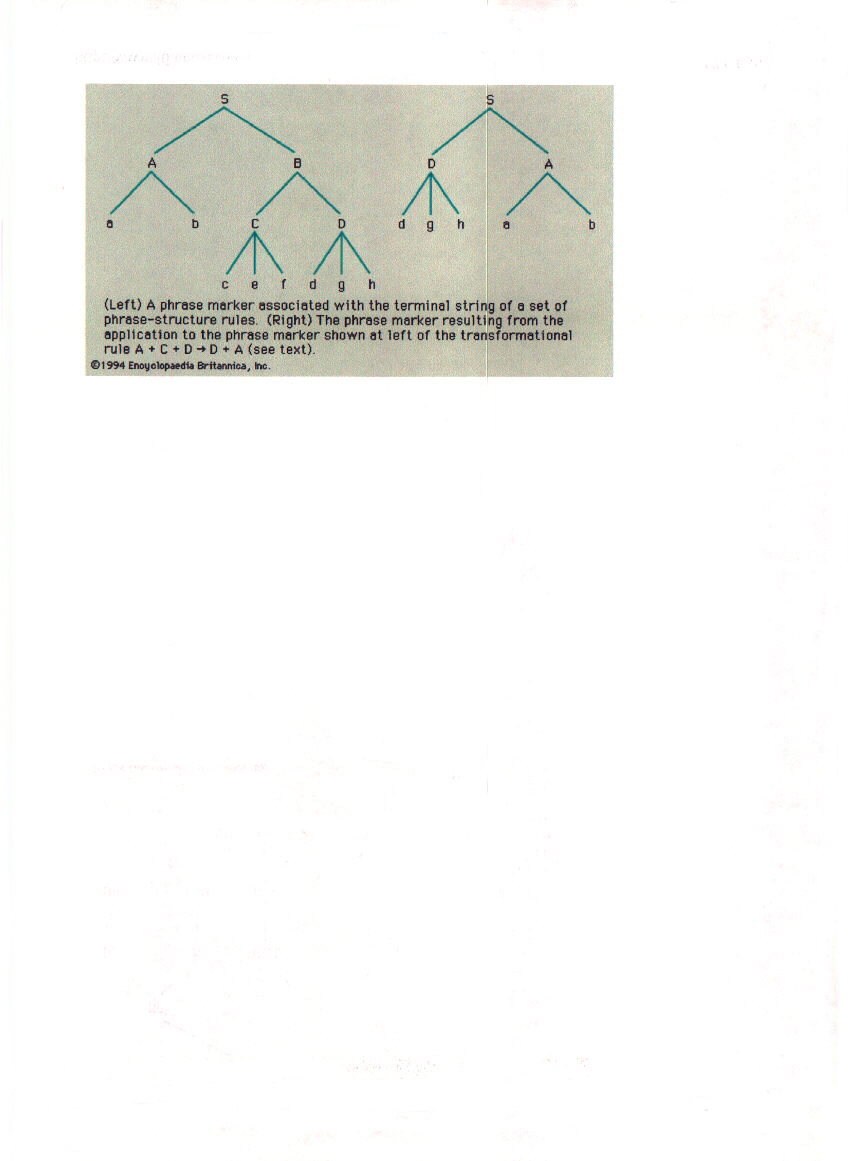
The output of rules(l)~(5)is the terrninal string a + b + c + e + f + d + g + h, wnich has associated with it the structual description indicated by the phrase marker shown in Figure 5 (left). Rule (6) applies to this terminal string of the PS rules and the associated phrase marker. It has the effect of deleting C (and the constituents of C) and permuting A and D (together with their constitents). The result is the string of symbols d + g + h + a + b, with the associated phrase marker shown if' Figure 5 (right).
Chomsky's rule for relating active and passive sentences
(as given in Syntactic Structures) is very similar, at first sight,
to Harris's, discussed above. Chonisky's rule is:
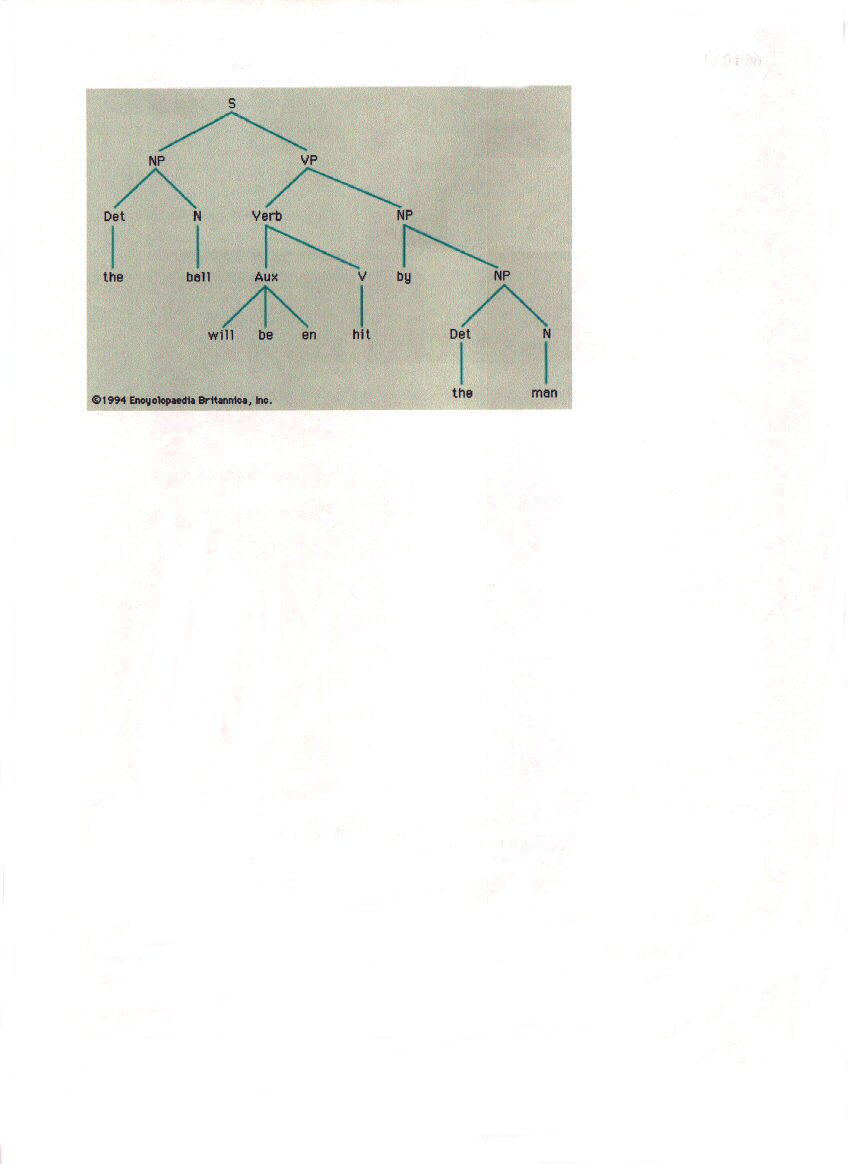
Every transformational rule has the effet of converting an underlying phrase marker into a derived phrase marker. The manner in which the transformational rules assign derived constituent structure to their input strings is one of the major theoretical problems in the formalization of transformational grammar. Here it can be assumed not only that "be + en" is attached to Aux and "by" to NP (as indicated by the plus signs in the rule as it has been formulated above) but also that the rest of the derived structure is as shown in Figure 6. The phrase marker in Figure 6 forinalizes the fact, among others, that "the ball" is the subject of the passive sentence "The ball will be hit by the man," whereas "the man" is the subject of the corresponding active "The man will hit the ball'9(cf Figure 4).
Although the example above is a very simple one,and only a single transformational rule has been considered independently of other transformational rules in the same system, the passive transformation must operate, not only upon simple noun phrases like "the man" or "the ball," but upon noun phrases that contain adjectives ("the old man"), modifying phrases ("the man in the corner'), relative clauses ("the man who checked in last night"), and so forth. The incorporation, or embedding, of these other structures with the noun phrase will be brought about by the prior application of other transformational rules. It should also be clear that the phrase-structure rules require extension to allow for the various forms of the verb ("is hitting," "hit," "was hitting," "has hit," "has been hitting," etc.) and for the distinction of singular and pluraL
It is important to note that, unlike Harris's, Chomsky's
system of transformational grammar does not convert one sentence into another:
the transformational rules operate upon the structures underlying sentences
and not upon actual sentences. A further point is that even the simplest
sentences (i.e.,kernel sentences) require the application of at least some
transformational rules. Corresponding active and passive sentences, affimative
and negative sentences, declarative and interrogative sentences, and so
on are formally related by deriving them from the same underlying terminal
string of the phrase-structure component. The difference between kernel
sentences and nonkernel sentences in Syntactic Structures (in Chomsky's
later system the category of kernel sentences is not given formal recognition
at all) resides in the flict that kernel sentences are generated without
the application of any optional transformations. Nonkernel sentences require
the application of both optional and obligatory transformations, and they
differ one from another in that a different selection of optional transformations
is made.
©Copyright 1998-1999. Irene Francés Martí.