Joyce
and "Finnegans Wake

 aJames Joyce by Gentilini.
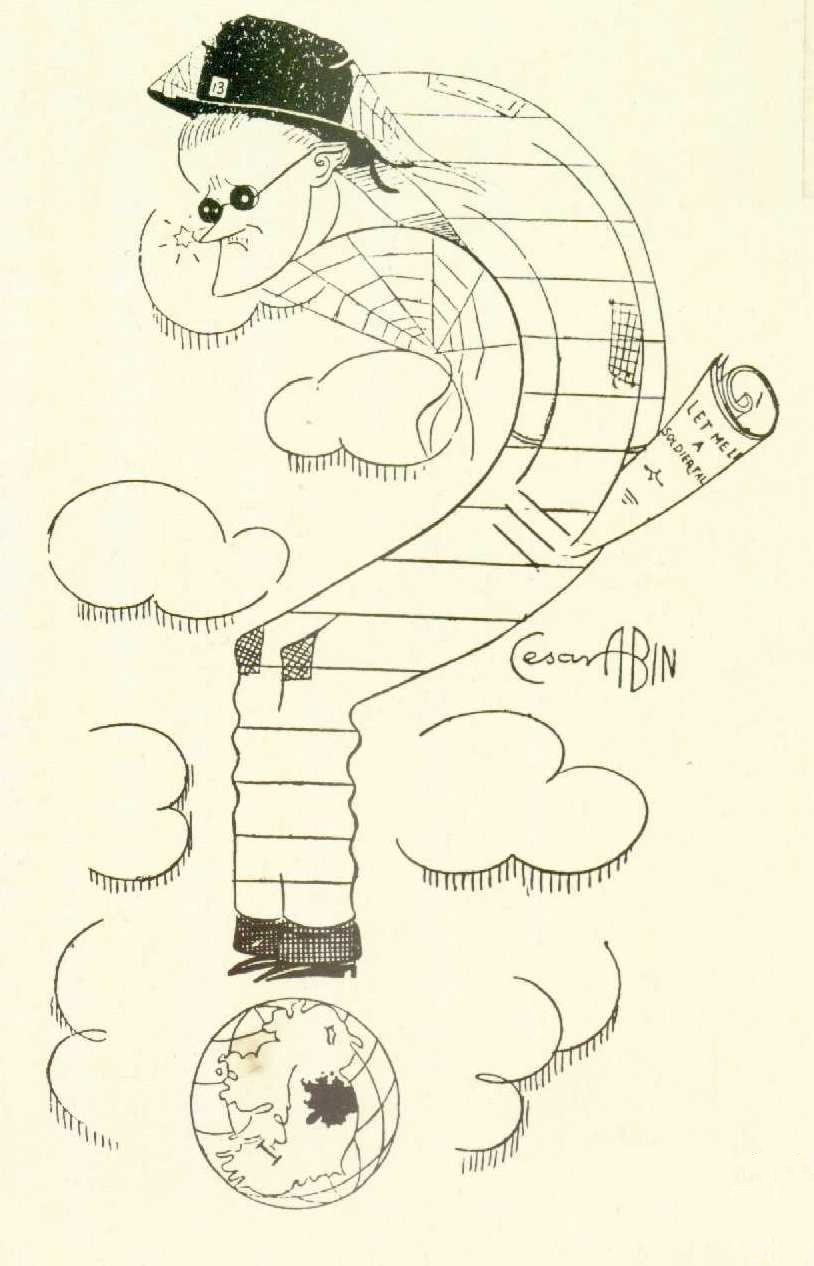
A caricature of Joyce by Cesar Abin.
INTRODUCTION
aJames Joyce by Gentilini.
A caricature of Joyce by Cesar Abin.
INTRODUCTION
The first thing to say about "Finnegans Wake" is that it is, in an important
sense, unreadable. In order to pay attention it so impertinently and endlessly
demands, the reader must forego most of the conventions about reading and
about language that constitute him and her as a reader. The advantage to
be gained from doing so is considerable: the conventions survive but they
are less likely thereafter to dwindle into assumptions about what reading
or writing is. Joyce´s last great work is an extraordinary performance,
a transcription into a miniaturized form of the whole western literary
tradition, it is Joyce´s outstanding mastery of that form and his
amazing powers of transcription that show this to be an unrepeatable, solo
performance that need, in a sense, only be looked at rather than "read"
to provide a sufficient impression of its radical, unique status. It is
difficult to say that the Wake is a novel: equally difficult to deny
it. Few words erase the author as individual voice and genius more effectively:
none affirms that the role more loudly and scandalously. It is a book that
opens itself to all of history, culture and experience: yet no book is
more closely imprisoned within a conception of art as a specialized activity
that relies for its preservation and interpretation on a cadre of dedicated
specialists. The Wake has a narrative drive that allows us to believe that
it has within it one governing and completed story: but it also has so
many disgressions and repetitions that it is only with some desperation
that the reader can sustain a belief in the primacy of this narrative impetus.
When its primacy comes into question, then the whole issue of what is central
and what is disgressive arises with such force that the practice of reading
"for the story" has to be abandoned. These conflicts are deeply embedded
in the various traditions, literary and historical, that Joyce inherited
and elaborated, but no writer excavated them with a comparable thoroughness
and glee.
©
Copyright Joan Esteve Delcamp
This
page is mantained by Joan Esteve Delcamp
created
17/5/99