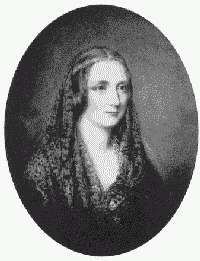
Mary Wollstonecraft Shelley, born August 30, 1797 in Somers Town, Great Britain. She was a prominent, though often overlooked, literary figure during the Romantic Era of English Literature. She was the only child of Mary Wollstonecraft, the famous feminist who dies as the result of Mary’s birth, and William Godwin, a philosopher and novelist. Her father and a much-resented stepmother therefore raised Mary. She also was the wife of the poet Percy Bysshe Shelley. Mary’s parents were shapers of the Romantic sensibility and the revolutionary ideas of the left wing. Mary, Shelley, Byron and Keats were principle figures in Romaticism´s second generation. Whereas the poets died young in the 1820´s, Mary lived through the Romantic era into Victorian.
Mary was born during the eighth year of the French Revolution. "She entered the world like the heroine of a Gothic tale: conceived in a secret amour, her birth heralded by storms and portents, attended by tragic drama, and known status in his Dedication to The Revolt of Islam" (from pg. 21 of Romance and Reality by Emily Sunstein). From infancy, Mary was treated as a unique individual with remarkable parents. High expectations were placed on her potential and she was treated as if she were born beneath a lucky star. Godwin was convinced that babies are born with a potential waiting to be developed. From an early age famous philosophers, writers, and poets surrounded her: Coleridge made his first visit when Mary was two years old. Charles Lamb was also a frequent visitor. A peculiar sort of Gothicism was part of Mary’s earliest existence. Most every day she would go for a walk with her father to the St. Pancras churchyard where her mother was buried. Godwin taught Mary to read ad spell her name by having her trace her mother’s inscription on the stone.
When Mary is sixteen she meets the young poet Percy Bysshe Shelley, a devotee of her father´s teachings. Together with Mary´s stepsister, the run off to continental Europe several times, not hindered by the fact that Shelley was already married. Percy was unhappily married radical heir to a wealthy baronetcy. To Mary, Shelley personified the genius and dedication to human betterment that she had admired her entire life. Although even her father cast her out of Society, this inspirational liaison produced her masterpiece, Frankenstein. She conceived of Frankenstein during one of the most famous house parties in literary history when staying at Lake Geneva in Switzerland with Byron, his friend Polidori and Shelley in 1816. Mary writes Frankenstein, the only story of the four that was ever to be published as a novel. Interestingly enough, she was only nineteen at the time. She wrote the novel while being overwhelmed bye a series of calamities in her life. The worst of these were the suicides of her half-sister, Fanny Imlay, and Shelley´s wife, Harriet. After the suicides, Mary and Shelley reluctantly married. Fierce public hostility toward the couple drove them to Italy. Initially, they were happy in Italy, but their two young children died there. Mary never fully recovered from this trauma. (Their first child had died shortly after birth early in their relationship.)
Nevertheless, Shelley empowered Mary to live, as she most desired to enjoy intellectual and artistic growth, love, and freedom. When Mary was only twenty-four Percy drowned during a sailing trip in 1822, leaving the penniless with a two-year-old son. For the remaining twenty-nine years she engaged in a struggle with the societal disapproval of her relationship with Shelley. Poverty forced her to live in England, which she despised because of the morality and social system. She was shunned by conventional circles and worked as a professional writer to support her father and her son. Her circle, however, included literary and theatrical figures, artists, and politicians. She eventually came to more traditional views of women’s dependence and differences like her mother before her. This not a reflection of her courage and integrity but derived from socialization and the conventions placed on her by Society.
She published several editions of Percy´s writings and ads notes and prefaces to them. She also continues writing her own novels, the most famous on being The Last Man (1826). This book deals with human isolation just as her earlier novel Frankenstein did. She writes numerous short stories and contributes biographical and critical studies to the Cabinet Cyclopaedia. Mary became an invalid at the age of forty-eight. She died in 1851 at the age of fifty-three of a brain tumour with poetic timing. The Great Exhibition, which was a showcase of technological progress, was opened. This was the same scientific technology that she had warned against in her most famous book, Frankenstein.
From:
www.desert-fairy.com/maryshel.shtml