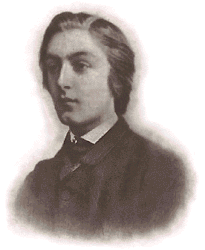
"Gerard Manley Hopkins: A Life" (Viking . 496 pages. $34.95), by Paul Mariani: Readers moved by religion, poetry and their effects on people's lives may be fascinated by this almost day-to-day account of English priest-poet Gerard Manley Hopkins. It's by an American poet who is also a biographer of American poets.
Hopkins died at 44 with little work published. He tried to destroy his poems when he converted to Catholicism as a top student at Oxford and began a career as a Jesuit priest. He decided that even religious poetry was too self-indulgent but later changed his mind. His mother and friends had kept copies of his early work.
Verse that was in large part passionately religious has earned him a reputation since his death as one of the greatest Victorian poets. In an interview, biographer Paul Mariani said some critics see him as superior to Alfred Tennyson and Robert Browning. Hopkins' imaginative vocabulary and his original ideas on versification led him to call his own work odd.
What can English 101 make, for example, of his own favorite poem, "The Windhover," that tells how a hawk in flight "rung upon the rein of a wimpling wing"? Browning, once thought a puzzler, may sound like Dr. Seuss by comparison.
Though personally close, British poet laureate Robert Bridges disliked both Hopkins' religion and some of his most innovative poetry. But he collected and published the poems after his friend's death.
One group who will appreciate Mariani's story will be those with the taste of American poet Hart Crane, the subject of an earlier Mariani biography. Crane was captivated by Hopkins' precedent-breaking verse, its music and "minute literal signification."
"What daring!" Crane wrote.
Mariani calls that "genius speaking to genius."
Hopkins invented — or, as he might say, revived — what he called "sprung rhythm." Instead of regular patterns of stressed and unstressed syllables, he put his trust on the stressed sounds. His unstressed syllables may be spoken faster and they can be few or many, but unlike free verse, his poems preserve rhyme and traditional form like the sonnet. They are to be read by the ear, not the eye, he said.
Others drawn to the story will be sentimental enough to sympathize, 120 years after his death, with the deep disappointments that made up Hopkins' life. His conversion brought much pain to his large and close Anglican family. On his father's letter of remonstrance Hopkins' mother added just one line to the eldest of her eight children: "O Gerard my darling boy are you indeed gone from me?"
Despite his outstanding record as student, conversion made it impossible for him to become a professor at Oxford like his mentor, the critic Walter Pater.
Hopkins rejoiced at his acceptance into the Jesuit order. But after years of additional study, Jesuit examiners barred him from taking a fourth and final year of theology. That refusal made it certain he could not rise in the Jesuit hierarchy.
After hesitating for months, a Jesuit magazine turned down his memorial ode to five exiled nuns drowned in a shipwreck, which marked his return to poetry. He also sent the ode to Bridges, who replied that he read it once and would not read it again for any money.
Hopkins' last four years were spent teaching Latin and Greek at University College in Dublin. He was depressed by the chores of devising and grading examinations for large numbers of students, far less advanced than those of his beloved Oxford.
But he continued to write his unpublished poetry.
Dying of typhoid, his last words — reported by his nurse, a fellow Jesuit — were whispered over and over: "I am so happy. I am so happy."
Mariani thinks they may have been an expression of satisfaction at having done his duty to his faith.