Our Man in
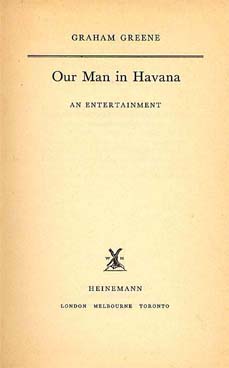
© http://bp2.blogger.com/_7W-EMkyswto/RmWyZMe7UrI/AAAAAAAAABc/Ax_3cW0SCP0/s1600-h/havana.jpg

My
friends Logan and Amanda just got back from
Graham Greene’s “Our Man in
I love the premise of this book. James Wormold, the
middle-aged ‘hero’ of the story, is a soft-spoken, mediocre Englishman who has
lived in pre-Castro Havana for 20 years running his small, struggling vacuum
cleaner shop. He has one friend with whom he spends about six minutes each day,
is still in love with the wife who left him a decade earlier, and the
possessions he cares about would fit in a single crate.
That sounds like an incredibly boring start, but Wormold
has a pretty, spunky 17-year-old daughter named Millie who keeps things
interesting right from the beginning. Most of his energy is spent worrying
about her and trying to protect her – though she seems capable of handling
herself just fine.
When the opportunity to join the British MI6 spy agency comes literally walking
though the door of his shop, he decides he needs the money – and probably the
distraction --badly enough to join up.
One of his key responsibilities is to recruit Cuban agents to supply intelligence,
but rather than doing so Wormold sets about inventing
fictional characters to fill the roles, picking names randomly from a list of
country club members. The problem is, he does too good a job and his colourful cast of non-existent spies
begin bringing in information that makes his superiors in
In response to his good work
This is where things begin to become complicated for Wormold.
His until now seemingly harmless charade suddenly becomes serious, as he needs
to strengthen the web he has created around his fake agents in order to make
them stand up under scrutiny.
This, he also does well – so well that Beatrice begins to fall in love with
Raul, the alcoholic Cuban airline pilot Wormold has
‘recruited’ to fly surveillance missions and collect images of the massive,
non-existent military constructions his spies have reported on. One of Wormold’s more colourful
character studies, Raul has lost his wife in a massacre during the Spanish
civil war and has become disillusioned with both sides, especially the
communists, making him an ideal recruit – and an
sparking intrigue in Beatrice.
This is a problem for Wormold, who has fallen in love
with her and becomes irrationally jealous over the fictional character he
invented as a reflection of some of the romantic aspects of his own
personality.
Sometimes Wormold felt a twinge of jealousy
towards Raul and he tried to blacken the picture.
“He gets through a bottle of whisky a day,” he said.
“It’s his escape from loneliness and memory,” Beatrice said. “Don’t you ever
want to escape?”
“I suppose we all do sometimes.”
“I know what that kind of loneliness is like,” she said with sympathy. “Does he
drink all day?”
“No, the worst hour is two in the morning, When he
wakes then, he can’t sleep for thinking, so he drinks instead.” It astonished Wormold how quickly he could reply to any questions about
his characters; they seemed to live on the threshold of his consciousness – he
had only to turn a light on and there they were, frozen in some characteristic
action.”
But soon, Beatrice’s fascination with Raul becomes the least of his problems,
as Captain Segura, a feared member of the
Entertaining and clever, OMIH is partly a satirical mockery of the British
secret service, and partly a criticism of Cuban corruption in the 50s.
Greene was well positioned to provide first-hand descriptions and criticisms of
both. He actually served as an MI6 intelligence agent during the Second World
War, attempting to send spies into global hotspots and later working in
counter-espionage in
© http://cityscrivener.blogspot.com/2007/06/our-man-in-havana-graham-greene-1958.html