People are always wondering what were an author's influences, upon what great writer or writers did he model himself, who offered the most inspiration, which ones affected his style most, and so on. Henry intends presently to give the line of his descent, in as strictly chronological order as possible. He gives specific names and he includes a few men and women (some of them not writers at all) whom he regard as "living books", meaning by this that they had ( for him ) all the weight, power, prestige, magic and sorcery which are attributed to the authors of great books. He also includes a few "countries", they are, all of them, countries he has penetrated only through reading, but they are as alive for him and has affected his thought and behaviour as much as if they were books.
When he looks over his list, which never ceases to grow, he is appalled by the obvious waste of time which the reading of most of these books entailed. It is often said of writers that "all is grist for the mill". Like all sayings, this one too must be taken with a grain of salt. A writer needs very little to stimulate him. The fact of being a writer means that more than other men he is given to cultivating the imagination. Life itself provides abundant material, superabundant material. The more one writes the less books stimulate. One reads to corroborate, that is, to enjoy one's own thoughts expressed in the multifarious ways of others.
In youth's one appetite, both for raw experience and for books, is uncontrolled. Where there is excessive hunger, and not mere appetite, there must be vital reason for it. We would not need substitutes, we would not accept vicarious modes of existence. This applies for all realms: food, sex, travel, religion, adventure. We get off to a bad start. We travel the broad highway with one foot in the grave. We have no definite goal or purpose, nor the feedom of being without goal or purpose. We are, most of us, sleepwalkers, and we die without ever opening our eyes.
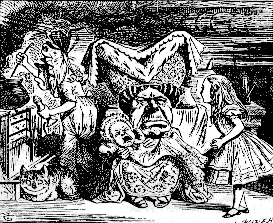
And here are the names. First of all come the books of childhood those dealing with legend, myth, tales of imagination, all of them saturated with mystery, heroism, supernaturalism, the marvelous and the impossible, with crime and horror of all sorts and all degrees, with cruelty, with justice and injustice, with magic and prophecy, with perversion, ignorance, despair doubt and death. These books formed his character, his way of looking at life, his attitude towards women, society, laws, morals, government.His specific influences commence are at the brink of manhood, from the time he first dreamed that he too might one day become " a writer". Some examples are: Boccaccio, Whitman, Emerson, Thoreau, Heraclitus, Nietzsche, Dostoievski, D.H.Lawrence, James Joyce, Lewis Carroll.
For him, the only true revolutionaries are the inspirers and the activators, figures like Jesus, Lao-Tse, Guatama the Buddha, Akhnaton, Ramakrishna, Krishnamurti. The yardstick he employs is life: how men stand in relation to life.
And finally for "the living books"... several times he has said that there were men and women who came into his experience, at various times, whom he regards as "living books".
He has explained why he refers to them in this fashion. They stay with
him, these individuals, as do the good books. He can open them up at will,
as he would a book. The books they left him are their lives, their thoughts,
their deeds. It was the fusion of thought, being and act which made each
of these lives singular and inspiring to him. Clear examples are: Emma
Goldman, Hubert Harrison, Elizabeth Gurley Flynn, Jim Larkin, Blaise Cendrars.
These names are the ones he shall always revere, the ones he feels forever
indebted to.