INTRODUCTION
The literary production of the Victorian Great Britain is wide and
vast. It is an age of big and important changes, and the literature suffered
a renewing, too.
A certain realism is now preferred to the romantic sentimentalism
and the necessity of explain the phenomenons is the reason of the use of
a new expression´s way (fresher and with a better understanding)
instead the use of the difficult and refined language of the last years.
Stevenson is the clearest example of the Victorian writer, which,
after the crisis of the romanticism, tries to find his own way of expression.
However, the most representative writer was Charles Dickens.
An important contrast is the main characteristic of Stevenson´s
work: while men are considered a passive subject of the History, he believed
that the man could be an individual and free essence, able to life everyday
as a new adventure.
BIOGRAPHY
Robert Louis Balfour Stevenson was born in Edinburgh on 13 November
1850. His father Thomas belonged to a family of engineers who had built
many of the deep-sea lighthouses around the rocky coast of Scotland. His
mother, Margaret Isabella Balfour, came from a family of lawyers and church
ministers. In 1857 the family moved to 17 Heriot Row, a solid respectable
house in Edinburgh’s New Town.
At the age of seventeen he enrolled at Edinburgh University to study
engineering, with the aim - his father hoped - of following him in the
family firm. However, he abandoned this course of studies and made the
compromise of studying law. He 'passed advocate' in 1875 but did not practice
since by now he knew he wanted to be a writer. In the university’s summer
vacations he went to France to be in the company of other young artists,
both writers and painters. His first published work was an essay called
‘Roads’, and his first published volumes were works of travel writing.
He died in December 1894 and even shaped the manner of his burial:
as he had wished, he was buried at the top of Mount Vaea above his home
on Samoa. Appropriately it was his own short poem, ‘Requiem’ (from an 1887
collection), that was written on his tomb: ‘Under the wide and starry sky,
/ Dig the grave and let me lie...’
GO TO THE INDEX
BIOGRAPHY: His first published volume, An Inland Voyage (1878),
is an account of the journey he made by canoe from Antwerp to northern
France, in which prominence is given to the author and his thoughts. A
companion work, Travels with a Donkey in the Cevennes (1879), gives
us more of his thoughts on life and human society and continues in consolidating
the image of the debonair narrator that we also find in his essays and
letters (which can be classed among his best works).
Short stories: Stevenson’s first published fictional narrative
was ‘A Lodging for the Night’ (1877), a short story originally published
in a magazine, like other early narrative works, such as ‘The Sire De Malétroit’s
Door’ (1877), ‘Providence and the Guitar’ (1878), and ‘The Pavilion on
the Links’ (1880, considered by Conan Doyle in 1890 as ‘the high-water
mark of [Stevenson’s] genius’ and ‘the first short story in the world’,
qu. Menikoff 1990: 342). These four tales were collected in a volume entitled
New
Arabian Nights in 1882, preceded by the seven linked stories originally
called ‘Latter-Day Arabian Nights’ when published in a magazine in 1878.
This collection is seen as the starting point for the history of the English
short story by Barry Menikoff (1987: 126). The Arabian stories were described
by critics of the time as ‘fantastic stories of adventure’, ‘grotesque
romances’
‘in which the analytic mind loses itself’ (Maixner 1981: 117,
120), and are seen by Chesterton (1927: 169) as ‘unequalled’ and ‘the most
unique of his works’. They have an affinity with the Strange Case of
Dr Jekyll and Mr Hyde in their setting in the labyrinthine modern city,
and the subject matter of crimes and guilty secrets involving respectable
members of society. Stevenson continued to write short stories all his
life, and notable titles include: ‘Thrawn Janet’ (1881), ‘The Merry Men’
(1882), ‘The Treasure of Franchard’ (1883), ‘Markheim’ (1885), which, being
a narrative of the Double, has certain affinities with Dr Jekyll and
Mr Hyde, ‘Olalla’ (1885), which like Dr Jekyll and Mr Hyde originated
in a dream and which also deals with the possibility of degeneration. The
above short narratives were all collected in The Merry Men and Other
Tales and Fables in 1887.
‘Olalla’ was written in the period of just over two years (1885-7) when
Stevenson and Fanny were living in Bournmouth. Despite problems of health
and finances, this was a period of meetings with Henry James, W.E. Henley
and other literary figures, and when he wrote the long short-story (published
as a single volume), his ‘breakthrough book’, the Strange Case of Dr
Jekyll and Mr Hyde (1886).
Another collection Island Nights’ Entertainments, tales with
a South Sea setting, was published in 1893, including ‘The Bottle Imp’
(1891), ‘The Beach of Falesà’ (1892, a long short story of the same
length as Dr Jekyll and Mr Hyde), and ‘The Isle of Voices’ (1893).
TREASURE ISLAND AND ‘CHILDREN’S LITERATURE’: Another fortuitous turning-point
in Stevenson’s life had occurred when on holiday in Scotland in the summer
of 1881. The cold rainy weather forced the family to amuse themselves indoors,
and one day Stevenson and his twelve-year-old stepson, Lloyd (Fanny’s son
by her first marriage), drew, coloured and annotated the map of an imaginary
‘Treasure Island’. The map stimulated Stevenson’s imagination and, ‘On
a chill September morning, by the cheek of a brisk fire’ he began to write
a story based on it as an entertainment for the rest of the family. Treasure
Island (published in book form in 1883) marks the beginning of his
popularity and his career as a profitable writer, it was his first volume-length
fictional narrative, and the first of his writings ‘for children’ (or rather,
the first of writings manipulating the genres associated with children).
Later works that fit into this category are A Child’s Garden of Verses
(1885), The Black Arrow (1883), Kidnapped (1886) and its
continuation Catriona (1893). The four narrative works mentioned
in this paragraph, though they all have youthful protagonists and were
all first published in magazines for young people, are also clearly intended
for adult readers. The last three, based on careful documentary research,
are fictions exploring history and culture; and the last two are interesting
studies of Scottish culture and could also be placed in the following section.
GO TO THE INDEX
NOVELS AND ROMANCES: Prince Otto (1885), his second full-length
narrative, is defined by Andrew Lang as ‘a philosophical-humouristical-psychological
fantasy’ (qu. Maixner 1981: 181). The action is provocatively set in the
imaginary state of Grünewald, an unusual choice for Stevenson, and
it was to historical Scotland (which had already provided the setting for
Kidnapped
and
Catriona)
that he turned for his next full-length ‘adult’ story,
The Master of
Ballantrae (1889). This is a Doubles narrative in which the brothers
James and Henry have similarities with Jekyll and Hyde, not only in their
initials, but also because of the mixed personality of the ‘good’ character,
the constant return of the persecuting Double, and the simultaneous death
of the two antagonists. Both Calvino and Brecht consider it to be the best
of his works, and it is highly praised by writers as diverse as Henry James,
Walter Benjamin and André Gide. The novel that he was working on
when he died, Weir of Hermiston (published incomplete and posthumously
in 1896), is also set in Scotland in the not-too-distant past and has also
been often praised and seen as Stevenson’s masterpiece. The centre of the
story is the difficult relationship of an authoritarian father and a son
who has to assert his own identity (a theme present in many of Stevenson’s
works - and we may remember that Hyde is presented in some ways as Jekyll’s
son - and clearly a way he used of exploring and coming to terms with his
difficult relationship with his own father).
THE MAP OF THE TREASURE ISLAND
He was with Lloyd Osborne when he painted the map of an imaginary island.He
added mountains, names and adventures and he considered the posibility
of writing a story with the island as scenery.The first step was decide
the name of John Silver, his friend.In that time the title of the novel
was "the cooker of board". Lloyd read the first chapters and he animated
Stevenson to continue.
THE FIRST PUBLICATION OF THE NOVEL
Its 1st publication was in "Young Folks Magazine" as a serie of chapters,
in 1881.It was published as a book in 1883.It was his first economic success.

PERSONAL COMMENTARY ABOUT THE NOVEL
Treasure Island is the way of the knowledge of a young man. Is the
story of a dream of freedom, of the scape to the sea and of the travel
as destinity. This is the answer of one of the deepest questions: how can
we live?
Stevenson establishes a personal relationship with the reader, and
creates a sense of wonder through his brilliant style and his adoption
and manipulation of a variety of genres. Writing when the period of the
three-volume novel (dominant from about 1840 to 1880) was coming to an
end, he seems to have written everything except a traditional Victorian
novel.
LITERARY INFLUENCES
Despite of his importance, Charles Dickens was not a really strong
influence of Robert Louis Stevenson. More than that, his biggest influence
was Daniel Defoe´s "The adventures of Robinson Crusoe". This work
inspired his adventure´s novels and his mystery novels were influenced
by the work of the American Edgar Allan Poe.
INLUENCES TO OTHER ARTS
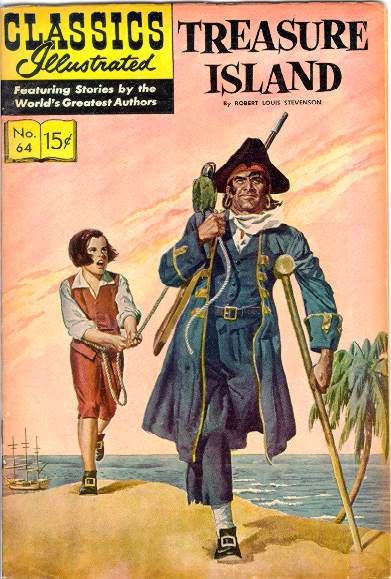
The work of Stevenson have influenced not only to Literature, but in
some other arts such as films, comics, theatral plays, or musicals. It
could be mentioned a lot of works based in Stevenson´s literature,
around a hundred of versions about all his writings. Despite the extension
of his literary work the clearest influent works of Robert Louis Stevenson
were ´The Strange Case of Dr Jeckyll and Mr Hyde´ and Treasure
Island. An example of a comic based on his Treasure Island is the next:
SUMMARY
Our narrator is Jim Hawkins, son of a guesthouse owner on the
west coast of England sometime in the eighteenth century. To the inn come
firstly an old buccaneer who has a map of Captain Flint’s treasure, and
secondly a group of pirates under the command of ominous blind man Pew.
Jim Hawkins, our hero, in an act of bravery and cunning gets hold of the
map before this rabid mob gets it. He delivers the map to Squire Trelawney,
and together they set off for Treasure Island in the Squire’s schooner.
The rest of the crew, apart from Dr Livesey (a friend of the squire) are
a company collected by Long John Silver. The latter and his men try to
mutiny and get hold of the treasure themselves but Jim intervenes and through
a series of enthralling adventures we find ourselves on Treasure Island
with the marooned Ben Gunn and ever closer to the treasure itself.
GO TO THE INDEX