
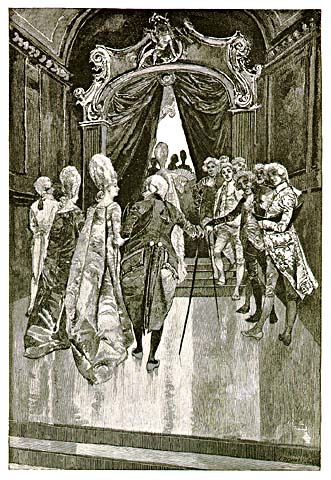
In "England and the Nineteenth Century," David Thompson describes the Victorian Age as "one of strenuous activity and dynamic change, of ferment of ideas and recurrent social unrest, of great inventiveness and expansion." ("The Victorian Age," The Norton Anthology of English Literature, II, 918) In the period between 1832 and 1901, England was caught in a whirl of social, economic, and religious changes. Many people applauded these changes. Many others were more inclined to agree with Matthew Arnold, who wrote that "repeated shocks, again, again / Exhaust the energy of strongest souls." (NA, II, 918)
Tennyson wrote the first draft of "Tithonus" in 1833, at the beginning of England's gratest period of industrialization and expansion. Like all major periods of transition, this one did not come easily; the first part of the Victorian Age (1832-1848) was one of tumult. Rapid industrial expansion and the laissez-faire economic system allowed the justification of horrible working condidtions, especially for children. Depression struck in the early 1840's; together with high tariffs on grain, this caused food shortages, and the hungry, ill-employed masses rioted.
By the middle Victorian
period, when Browning wrote "Cleon" (1855) and "Tithonus" was revised and
finally published (1860), the situation had changed to some extent. Tariff
and labor reforms had helped bring back general prosperity and contentment.
However, controversy was not dead; it had merely shifted from social and
economic condidtions to religion. The Utilitarians, reflecting on what
they considered to be the basic human needs, decided that a society that
listened to the voice of reason had no need to believe in religion. The
utilitarian views distressed the religious conservatives, who argued that
the Victorian Age, with its excesses and social problems, was in dire need
of the stability and comfort offered by traditional Christianity.
www.landow.stg.brown.edu/victorian/vn/victor3.html