PRESENTATION AND INTRODUCTION
It is necessary to begin this work of investigation
noticing and reporting of the position from which we are going to realize it.
In the "Victorianweb" the Nonsense develops as a genre that forms a
part of the Children's Literature. In order to develop a comparative study of
both elements, we will leave aside the above mentioned theory. That is to say,
we will try to relate them as if we spoke of literary independent trends, highlighting
their differences and similarities, it's obvious. We depart from this position
with the intention of not subordinating an element to other one, with the
determining ones that it would carry.
In a beginning, we would say that it is not easy to distinguish
among those works that concern to the children's literature and those that
simply it seems. In addition, the fact that there exist hundreds of books read
by a juvenile public it does not mean that they belong to the Children's
Literature. It's the case of several works of Dickens and Sccot.
The Children's Literature does not centre only on the
children and the young people, but also on the adult public. It is true that
the fundamental aim is to come to the young reader but, in many occasions, in
order that this fact takes place before they must give I dress well parents or
teachers. And not only it, the young men who in other times were reading
infantile works are the adults of now that continue reminding those writings
and that, in addition, transmit them to their children. Of there the importance
of the reinstatement of the former classic ones.
They exist and have existed multitude of speculations
brings over of the concrete dates in which the bases of the Children's
Literature are established. Trustworthier information places us in 1672, on the
two sets of religious tracts. According to a sociologist of the epoch this
literary trend came to its end due to the fact that the youth had suffered a
change and the children already were having sufficient information, which they
had obtained of the Children's Literature. In addition the Publisher's Circular
was assuring that the infantile books were more read by the adults that for the
own children. For my, the problem took root in that what at first had to be a
way to transmit the reading to the children (the parents), finished turning
into the commercial aim of the writers.
When we think about the juvenile literature, us one
comes to the head a way of writing easily to deal, with educations and morals,
in order that the children learn and benefit their education. An example of it
is The King of the Golden River, of John Ruskin, that child - adult
appears us as an example of the binomial. It is a question of a moral that it
shows us as the greed and the zeal to obtain material goods of immoral form is
self-destructive for the person. Ultimately the honesty and the humility is
imposed.
Nevertheless,
an author like Lewis Carroll is inside a few very different parameters. In
spite of concerning to the Children's Literature, great part of his work it's
dedicated to the Nonsense. Together with Edward Lear, Carroll, mathematician of
profession, was consolidated as the predecessor of this literary trend. We
speak about a type of writing in which rarely the words approach the reality
and in which, over everything, the principal element is the sound. In multitude
of occasions a concrete definition has tried to give and clarifying brings over
of what is the Nonsense, but the subjectivity reigns always in the attempt of
describing the above mentioned trend. For example, Noakes defined it like
"to universe of words ". It came near to the conclusion of which the
emotional detachment and detachment from meaning were the bases of a writing
which guidelines were very complicated to analyze.
Though the exact definition of the literature of
Nonsense would be the following one: Literary nonsense refers to genre of
literature, whether poetry or prose, that plays with conventions of language
and logic through to careful balance of sense and odd number - sense elements.
Its strict adherence to structure is balanced by semantic chows and play with
logic. Formal use diction and tone ploughs balanced with an inherent
topsy-turvyness and absurdity. The effect of nonsense is often caused by an
excess of meaning, rather than to lack of it. The genre is most easily
recognizable by the various techniques it use to believe yourself nonsensical
effects, such ace neologism and faulty cause and
effect.(http://en.wikipedia.org/wiki/Literary_nonsense).

A clear
example of absurdity (an object that speaks).
Scene provided
with an ironic important load.
DEALING WITH THE NONSENSE AND DEVELOPMENT OF EXAMPLES
For me this style of writing is
in the excess of meaning, since good stays of manifest in the definition. Lewis
Carroll provides to his texts of a logic that he tries to show like supreme and
that, repeated and developed to the end, turns in illogical. Test of it they
are them 3E Lewis Carroll Puzzles:
(a) All babies are
illogical.
(b) Nobody is despised
who can manage a crocodile.
(c) Illogical persons
are dispised.
As the subjects of this puzzle
are people, we take the universe as the set of all people. We will rewrite each
statement in the puzzle as an implication. First we define simpler statements,
|
B : it is a
baby |
|
L : it is
logical |
|
M : it can
manage a crocodile |
D : it is
despised , |
Where “it” in this context refers
to a general person. Then the three statements can be rephrased as
|
(a) B →
~L : If it is a baby then it is not logical. |
|
(b) M →
~D : If it can manage a crocodile then it is not despised. |
|
(c) ~L →
D : If it is not logical then it is despised. |
And the result would be the
following one: B → ~L → D →
~M .
(http://www.math.hawaii.edu/~hile/math100/logice.htm)
The excess of logic remains clear
in these writings. In them it appears since as across a chain of reasoning we
come to the nonsense. Every premise consists of two elements related between if
in such a way that it can only very clear that the second one is a property of
the first one. They are sufficient three reasoning in order that Lewis states
that the second element of the third premise is a property of the first element
of the first premise. Which is a totally crazy affirmation. So, according to
his theory, we would say that:
A baby is not logical. Since it's not logical,
it's despised. And as those that can capture a crocodile they are not despised
and the baby cannot, since the baby is despised. (B > ~L > D > ~M.)
The mistake is to think that
about a chain of reasoning A> B> C, not for that B is a property of To,
and for that C it is of B, means that C is a property of To. The situation
would change if what we had ahead was a relation of equivalence:
A: 2+3=5
B: 1+4=5
C: 6-1=5
For what: A=B=C.
And, therefore: A=C.
Another mistake is to think that the denial of
an element inside one reasoning carries obligatorily to the denial of other
one. That that one that can capture a crocodile is not despised it does not
mean that the one that could not do it yes it is.
Later we will stop to analyze one
of the exercises proposed by Lewis Carroll (http://www.math.hawaii.edu/~hile/math100/logice.htm):
All puddings are nice.
This dish is a pudding.
No nice things are wholesome.
From this text, we happen to
award a number to every element:
1 All puddings 2
nice.
3 This dish 4 pudding.
5 All nice things 6
unwholesome.
And of it, we would extract the
following thing:
1>2
3>6
5>6
For wich:
1>6
After analyzing the text proposed
by Carroll we have noticed that not only the excess of meaning takes the
illogical one to us, but also one of his reasoning (Not nice things ploughs
wholesome), that already is illogical of for yes.
In this type of logical exercises
we obviate that the first one and the third reasoning are the base on which is
supported the development of the above mentioned exercise and their senseless
result. We might say that the second reasoning is a reinforcement that benefits
the semantic chaos of the nonsense. In this case it's not like that, since the
second reasoning is totally simple and common.
RELATION BETWEEN
CHILDREN'S LITERATURE AND NONSENSE AND PARALLELISMS WITH OTHER AREAS
Some of the differences between the literary
Nonsense and the Children's Literature are clear. Understanding the children's
literature as “to literary genre whose primary audience is children, although
many books within the genre ploughs(plough) also enjoyed by teenagers and
adults" (http: //
en.wikipedia.org/wiki/Children's_literature) We might say that the
difference between both literary trends is not only in the absence or not of
sense inside the work in question. One
of the differences among both types of literature is the possibility that in the
nonsense the texts are not written in verse. Centring on the author that we are
analyzing, which took part in both literary trends, we verify that his works
inside the nonsense are very varied. We observe mathematical writings very
removed from the verse and exercises of logic based on rules of calculation
that small they have to see with the conventional literature.
Nevertheless, it turns out to be
very complicated to be exact at the moment of analyzing both trends and
correctly on having established the differences between both. This is due to
the fact that the differential line between both is very small and in occasions
a text appears us as an intersection among both. For example, Alice's
Adventures in Wonderland possesses the own fantasy of a juvenile book with its
morals and educations inside an animated context, but also the absurdity formed
of the behaviour of its prominent figures. Establishing a parallelism with the
American literature and saving, it's obvious, the differences, we might say
that you work as Alice's Adventures in Wonderland they are alike what is known
as Gothic Novel/Romance. We refer to the location of the action, to the
behaviour of the prominent figures... Both share scenes with fantastic
creatures and inexplicable facts.
 http://www.guiascostarica.com/alicia/txt_menu.htm
Classic image of Alice's Adventures in Wonderland.
It is obvious that the most
radical branch of the nonsense (puzzles and problems of logic) is not
transmitted from parents to children like education. I would dare to say that
the above mentioned branch is the link lost in the literary chain. As the black
sheep of the literature. Nevertheless, the most common nonsense we can deal as
the first step towards a type of ironic, absurd and satirical humour. As a
clear example of transgression that breaks the rules of the literature. We
speak about a humour that, accompanied of a comical way of quality, causes rage
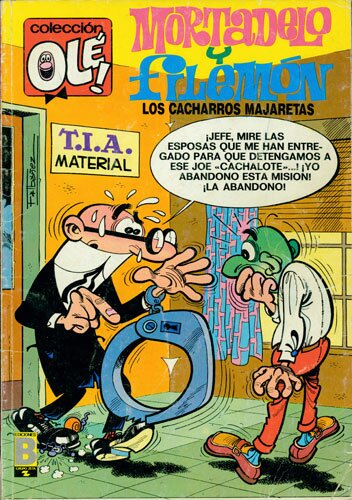
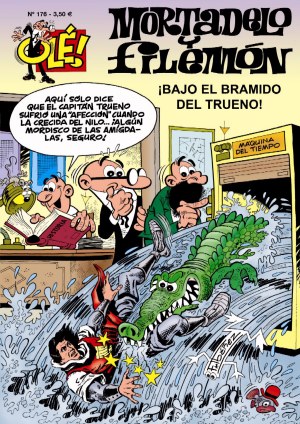
at present. According to my opinion, Carroll's nonsense is not another thing
that the base of the comical strips of Mortadelo & Filemón (based on
confusions due to the figurative sense of the words) or of so popular prominent
figures at present as Luisma of "Aída" (personage based on the
absurdity and the incongruities). In addition, the latter personage forms us of
the television series as a being unable to use the common sense. But when he
tries to do it he excels itself in such a way that it he submerges in relations
and illogical conclusions that they us remember remind to Carroll's puzzles,
analyzed previously. It demonstrates us that, in spite of that they could have
a logical reasoning; it is the common sense the one that shows us the
incongruity of this type of reasoning.


A) In this emblem we find an example of confusion, due to the figurative
sense of the words.
B) In this one we find an example of exaggeration.
C) In this emblem we find a clear example of absurdity. Though it is true
that both previous ones also us appear as absurd situations.
A B C
A) http://usuarios.lycos.es/personajesdetebeo/hpbimg/ole/ole121.jpg

B) http://www.piedepagina.com/comics/images/mortadelo-y-filemon_500.jpg
C) http://www.zonalibre.org/blog/elcoleccionistadtbos/archives/mortadelo176.jpg
When we say that the differences
between the children's literature and the nonsense are not clear, we refer to
the difficulty to frame some works that possess characteristics of both, inside
one of two literary trends. And the clear example is Alice's Adventures in
Wonderland. From the beginning, we have not limited ourselves to analyzing the
nonsense as a genre that forms a part of the Childen's Literature. We have
taken both concepts as independent and opened to being compared and, for that
not, differentiated. Returning to Carroll's masterpiece, we have selected a few
lines of one of his chapters.
ANALYSIS OF A
FRAGMENT OF ALICE'S ADVENTURES IN WONDERLAND
Chapter
5 - Advice from a Caterpillar
The Caterpillar and Alice looked at
each other for some time in silence: at last the Caterpillar took the hookah
out of its mouth, and addressed her in a languid, sleepy voice.
`Who are YOU?' said the
Caterpillar.
This was not an encouraging
opening for a conversation. Alice replied, rather shyly, `I--I hardly know,
sir, just at present-- at least I know who I WAS when I got up this morning,
but I think I must have been changed several times since then.'
`What do you mean by that?' said
the Caterpillar sternly. `Explain yourself!'
`I can't explain MYSELF, I'm
afraid, sir' said Alice, `because I'm not myself, you see.'
`I don't see,' said the
Caterpillar.
`I'm afraid I can't put it more
clearly,' Alice replied very politely, `for I can't understand it myself to
begin with; and being so many different sizes in a day is very confusing.'
`It isn't,' said the Caterpillar.
`Well, perhaps you haven't found
it so yet,' said Alice; `but when you have to turn into a chrysalis--you will
some day, you know--and then after that into a butterfly, I should think you'll
feel it a little queer, won't you?'
From this fragment we can extract
several conclusions that already we were anticipating (advancing) in lines
behind. In the text we think a caterpillar that it speaks, test of the
fantastic character of the work. In addition we meet the affirmation of which
the protagonist has changed of size several times in one day. One proves more
of fantastic effects. Also we observe the personification of the caterpillar,
not only at the moment of speaking, but also of smoking, which gives him a more
satirical and humorous air. But if we speak about the work as fantastic, also
we must speak about her as absurd, since these three mentioned examples also
are own of a senseless text. For it I would dare to say that the work possesses
characteristics of the Children's Literature and of the Nonsense.
In other parameters, we would
like to emphasize Alicia's role in Alice's Adventures in Wonderland. Inside a
surrealistic frame, the protagonist us appears as the personage who contributes
sanity to the history. Of some form, we might say that she realizes the
heroine's role inside the work. An example of the coherence about which we
speak we find it in the last fragment of the exposed text, when she asks the
caterpillar if she does not feel disconcerted when it realizes its physical
transformation. In addition another characteristic that we would like to
distinguish from this fragment is the ironic load that Alicia's words possess.
The common sense that Alicia shows in the work in occasions has a humorous
effect, which removes to the story of being a purely fantastic work.
COMPARISON OF THE
NONSENSE WITH ARISTOTLE'S LOGIC
It was turning
out to be to us inevitable to treat the topic of the logic inside the nonsense
and not to do allusion to Aristotle's logic. And in order to establish a
parallelism we will centre on the classification of judgments, specifically on
the syllogisms:
Syllogisms: It
is a reasoning where a conclusion is deduced departing from 2 judgments. This
one is shaped on 3 parts and in turn 3 terms. Three parts are: major Premise
(the most universal), minor Premise (less universal) and the conclusion. Three
terms that we mention are The major term and the minor term (Subject and Predicate
of the conclusion: S is P), Finally the average term (letter M) that appears in
both judgments.
There
are 4 valid forms of syllogism, all depending on the variation of the average
term and on its function in the judgments; listed later:
|
Figura 1 |
Figura 2 |
Figura 3 |
Figura 4 |
|
M
es P |
P
es M |
M
es P |
P
es M |
|
S
es M |
S
es M |
M
es S |
M
es S |
|
S
es P |
S
es P |
S
es P |
S
es P |

(http://es.wikipedia.org/wiki/L%C3%B3gica_aristot%C3%A9lica)
The difference is substantial between Aristotle's
logic and the logic that parts with Lewis Carroll's puzzles. For my
differential key it is undoubtedly the equivalence, Since we have developed in
the numerical example that we have mentioned in the page x, the common
denominator in Aristotle's syllogisms is the equivalence among their premises.
To speak about equivalence implies speaking about substitution. I explain.
Recapturing the Carroll's first puzzle, we would say that:
It is true that the babies are illogical persons. But
also it is true that all the illogical persons do not have why to be babies.
Since we have verified, the second premise is a property of the first one, but
a relation of equivalence does not join them between them.
Comparing this with the picture of Aristotle's
figures, we find rapidly the difference. If every premise (inside the picture
of the figures) was a word instead of a letter, inside a text we might replace
them between them without altering either the sense or the meaning. With the
premises of Carroll's puzzles the same thing would not happen.
LEWIS CARROLL
His original name was Charles
Lutwidge Dodgson. He was born in Cheshire (27/01/1832) and died in Guildford
(14/01/1898). This British writer also dedicated his life to the priesthood,
the photography, the mathematics or the logic. When we speak about Lewis
Carroll, we speak about an author on whom always he accompanied the polemic. It
was a question of a person carried away for photographing small girls. One of
them was Alice Liddell, on whom it was based, according to it is commented, to
write his principal work Alice's Adventures in Wonderland, though he
always denied it. His interest for the infantile photography fed the rumours on
his relation with the pederasty. Carroll began his career writing poems and
stories for magazines, which did not report too much success. He was a very
demanding writer with himself and consistent with his work. He itself was
recognizing the low level of his writings. Three years before the publication
of his principal work, he wrote a manuscript, Alice's Adventures Under
Ground, on which he based the later work. The above mentioned manuscript
was a request of the daughters of the family Liddell, between whom Alice was.
Due to the great Success of the work, Carroll published the second part:
Through the Looking-Glass and what Alice Found There. Later he published works
as The Hunting of the Snark, Sylvie and Bruno, or books of mathematical
character as The game of Logic and Euclid and his modern rivals.
Lewis Carroll was an author who dedicated his literary career principally to
the writing of humorous and satirical texts.
BIBLIOGRAPHY
http://www.literature.org/authors/carroll-lewis/alices-adventures-in-wonderland/chapter-05.html
http://www.textosentido.org/textosentido/resenas/alicia.html
http://images.google.es/images?hl=es&q=mortadelo+y+filem%C3%B3n&um=1&ie=UTF-8&sa=N&tab=wi
http://es.wikipedia.org/wiki/L%C3%B3gica_aristot%C3%A9lica
http://es.wikipedia.org/wiki/Lewis_Carroll
http://www.math.hawaii.edu/~hile/math100/logice.htm
http://en.wikipedia.org/wiki/Literary_nonsense
http://www.victorianweb.org/genre/childlit/index.html
http://www.victorianweb.org/genre/childlit/nonsense.html
http://www.biografiasyvidas.com/biografia/c/carroll.htm
http://www.guiascostarica.com/alicia/txt_menu.htm