
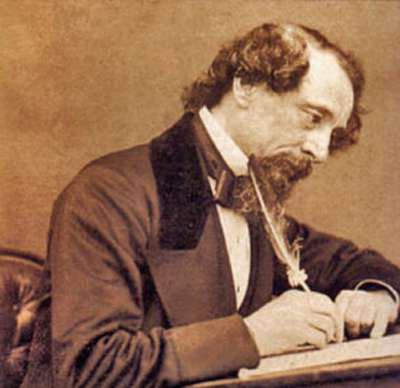
Charles Dickens,
a writer of the Industrial Revolution
Many of Dickens’ characters are the result of a series of circumstances produced by the Industrial Revolution: the working conditions, the configuration of the cities, the ideas about production and capitalism, etc. This means that Dickens’ novels, apart from being undoubtedly valuable pieces of literature, are also useful in terms of history knowledge. The same happens with most of the pieces of art: they tend to reflect the society that framed its creation. For this reason, when approaching a piece of art, we must be receptive to both its aesthetic and cultural characteristics.
TASK
After this connection has been established, the student will choose a couple of passages where, in his or her opinion, a circumstance of the Industrial Revolution has been most vividly depicted by Dickens, and he will link each of these passages with a picture of Gustave Doré’s “London, a Pilgrimage”

PROCESS
1. 1. The first step is to read the articles about the Industrial Revolution, in order to create a list of the main circumstances of this historical moment. You should focus in things like: the population migrations, the working conditions, the characteristics of industrial cities, and, in general, in the relation between industrial changes and social changes.
2. 2. In this second step, you are required to read the information about Dickens’ works, so as to achieve a basic idea of the connection between this author and the social and urban characteristics of the Industrial Revolution.
3. 3. After this, you will choose the novel by Dickens which in your opinion is most closely related with the conditions of the Industrial Revolution. If you don’t know what Dickens’ novels are about, you will base your choice on the reading of the synopsis of the novels.
4. 4. In this fourth step, you will read the novel you have chosen, keeping in mind these questions:
a. Which characteristics of the industrial revolution are reflected in this novel?
b. In your opinion, what Dickens’ thought or felt about the social situations that his novel describes?
5. 5. After reading the novel, you will go back to the list of the characteristics of the Industrial Revolution that you created in the first point of this task, and you will try to think of two or three brief passages of the novel you have just read in which some of the characteristics of your list are most clearly recreated by Dickens.
6. 6. Finally, you will look at the illustrations by Gustave Doré in his work “London, a Pilgrimage”, and you will link them to either the passages you have selected from the novel or to the points of your list of Industrial Revolution characteristics.
Example:
|
Industrial Revolution characteristics |
Passage from “Oliver Twist” |
Gustave Doré’s illustration |
|
Overpopulation in urban areas, bad conditions in the cities, poverty. |
To reach this place, the visitor has to penetrate through a maze of close, narrow, and muddy streets, thronged by the roughest and poorest of water-wide people. |

|