How did she do it?
She
was an accident-prone grandmother, who fitted writing into the gaps in family
life, and her first publisher dismissed her as 'an amateur writer'. But she
became the best English novelist of her time. Julian Barnes pays tribute to
Penelope Fitzgerald
The Guardian, Saturday July 26 2008
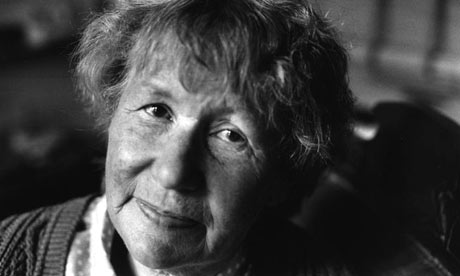
Shy and rather distrait ... Penelope Fitzgerald.
Photograph: Jane Bown
About 10 years ago I appeared on
a panel at York University with Penelope Fitzgerald. I knew her slightly, and
admired her greatly. Her manner was shy and rather distrait, as if the last
thing she wanted was to be taken for what she then was: the best living English
novelist. So she comported herself as if she were a jam-making grandmother who
scarcely knew her way in the world. This wasn't too difficult, given that she
was indeed a grandmother, and also - one of the minor revelations in her
forthcoming Letters - a jam (and chutney) maker. But the disguise wasn't
convincing, since every so often, as if despite herself, her rare intelligence
and instinctive wit would break through. Over coffee I produced, fan-like,
copies of my two favourite novels of hers: The Beginning of Spring and The Blue
Flower. She hunted around for a long while in the heavy plastic carrier-bag -
purple, with a floral design, I remember - that contained her day's
requirements. A fountain pen was eventually discovered, and after considerable
pausing and reflection, she wrote - as it seemed, as I hoped - a private,
encouraging message to a younger novelist on each title-page. I put the books
away without looking at the inscriptions.
The event
proceeded. Afterwards, we were driven to York station to travel back to London
together. When invited, I had been given the option of a modest fee and
standard-class travel, or no fee and a first-class ticket. I had chosen the
latter. The train drew in. I assumed that the university could not possibly
have given an octogenarian of such literary distinction anything other than a
first-class ticket. But when I set off towards what I assumed to be our
carriage, I saw that she was heading in a more modest direction. Naturally, I
joined her. I can't remember what we talked about on the journey down; perhaps
I mentioned the odd coincidence that we had both made our first hardcover
fictional appearance in the same book (The Times Anthology of Ghost Stories,
1975); probably I asked the usual daft questions about what she was working on
and when the next novel would appear (I later learned that she frequently lied
to interviewers). At King's Cross I suggested that we share a cab, since we
both lived in the same part of north London. Oh no, she replied, she would take
the Underground - after all, she had been given this splendid free pass by Ken
Livingstone. Assuming it must feel an even longer day to her than to me, I
pressed for the taxi option, but she was quietly obstinate, and came up with a
clinching argument: she had to pick up a pint of milk on the way from the
Underground station, and if she went home by cab it would mean having to go out
again later. I ploddingly speculated that we could very easily stop the taxi
outside the shop and have it wait while she bought her milk. "I hadn't
thought of that," she said. But no, I still hadn't convinced her: she had
decided to take the Underground, and that was that. So I waited beside her on
the concourse while she looked for her free pass in the tumult of her carrier
bag. It must be there, surely, but no, after much dredging, it didn't seem to
be findable. I was by this point feeling - and perhaps exhibiting - a certain
impatience, so I marched us to the ticket machine, bought our tickets, and
squired her down the escalator to the Northern Line. As we waited for the
train, she turned to me with an expression of gentle concern. "Oh
dear," she said, "I do seem to have involved you in some low forms of
transport." I was still laughing by the time I got home and opened her
books to read those long-pondered inscriptions. In The Beginning of Spring she
had written "best wishes - Penelope Fitzgerald"; while in The Blue
Flower - a dedication that had taken considerably more thought - she had put
"best wishes - Penelope".
Like her personal
manner, her life and literary career seemed designed to wrong-foot, to turn
attention away from the fact that she was, or would turn into, a great
novelist. True, she came from a cultured background, having one father and
three uncles among the multi-talented Knox brothers, whose communal biography
she later wrote. Her father was editor of Punch; her mother, one of the first
students at Somerville College, Oxford, also wrote. Penelope was in turn a
brilliant student at Somerville: one of her finals examiners was so astounded
by her papers that he asked his fellow dons if he could keep them, and later,
apparently, had them bound in vellum. But after this public proof of
distinction, throughout what might for anyone else have been the best writing
years of her life, she became a wife and working mother (at Punch, the BBC, the
Ministry of Food, then in journalism and teaching). She was 58 by the time she
published her first book, a biography of Burne-Jones. She then wrote a comic
thriller, The Golden Child, to amuse her dying husband. In the period 1975-84
she published two more biographies and four more novels. Those four novels are
all short, and written close to her own experiences: of running a bookshop,
living on a houseboat, working for the BBC in wartime, teaching at a stage
school. They are adroit, odd, highly pleasurable, but modest in ambition. And
with almost any other writer you might think that, having used up her own life,
she would - being now in her late 60s - have called it a day. On the contrary:
over the next decade, from 1986 to 1995, she published the four novels -
Innocence, The Beginning of Spring, The Gate of Angels and The Blue Flower - by
which she will be remembered. They are written far from her obvious life, being
set, respectively, in 1950s Florence, pre-revolutionary Moscow, Cambridge in
1912, and late 18th-century Prussia. Many writers start by inventing away from
their lives, and then, when their material runs out, turn back to more familiar
sources. Fitzgerald did the opposite, and by writing away from her own life
liberated herself into greatness.
Even so, when
public recognition came, it followed no obvious trajectory, and was attended by
a certain level of male diminishment. In 1977 her non-fiction publisher,
Richard Garnett, informed her dunderheadedly that she was "only an amateur
writer", to which she responded mildly, "I asked myself, how many
books do you have to write and how many semi-colons do you have to discard
before you lose amateur status?" The following year, after having been
shortlisted for the Booker prize with The Bookshop, she asked her fiction
publisher, Colin Haycraft, if it would be a good idea to write another novel.
He jocundly replied that if she went on writing fiction he didn't want it
blamed on him, and in any case he already had too many short novels with sad
endings on his hands. (Unsurprisingly, Fitzgerald took herself off to another
publisher, and Haycraft claimed he had been misunderstood.) I remember Paul
Theroux telling me how, as a Booker judge in 1979, he had been doing his preliminary
reading while travelling through Patagonia by train, and would skim out into
the pampas books he considered not even worth discussing. Some months later he
found himself with a polite smile on his face as the prize was awarded to
Offshore. The BBC's resident bookheads also treated her condescendingly:
radio's Frank Delaney told her she "deserved to win because my book was
free of objectionable matter and suitable for family reading"; while
television's Robert Robinson gave her patronisingly little airtime on The Book
Programme and scarcely concealed his view that she shouldn't have won. And
after she died, even her memorial meeting was disfigured by the turkey-cocking
of a young male novelist.
Fitzgerald
commented on Robinson's behaviour in a letter to Francis King about the Booker
evening. She had arrived at the studio "soaking wet because I'd had to be
photographed on a bale of rope on the Embankment". Robinson "was in a
very bad mood and complained to his programme executive, 'Who are these people
- you promised me they were going to be the losers'." You could perhaps
argue that she won the Booker with the "wrong" novel - which would
hardly be revolutionary in the history of the prize - though the real dishonour
was that she failed to win it again for any of her last four novels. The Blue
Flower, chosen more times than any other as Book of the Year in 1995, was not
even shortlisted. However, she did have a few happy memories of her Booker
victory night: "The best was when the editor of the Financial Times, who
was on my table, looked at the cheque and said to the Booker McC chairman,
'Hmph, I see you've changed your chief cashier.' Both their faces were alight
with interest."
There are many
such moments in the Letters - moments when the professional observer of human
beings finds sustenance and reward where others might find boredom or rudeness.
Her life, on this evidence, was largely domestic, frequently peripatetic, and
attended by regular economic crises. The magazine she edited, World Review, collapsed;
her husband Desmond had trouble with drink; the houseboat they lived on sank
not once but twice, carrying with it such archives as she possessed (including
all her wartime letters to her husband, who is not represented here by a single
item). Penelope and Desmond were, in the words of their son-in-law Terence
Dooley, "two kind, intelligent and funny people who simply couldn't manage
the world". Rescue at one point came in the shape of a council flat in
Clapham, where the novelist collected Green Shield stamps and used teabags to
dye her hair. Her writing had to be fitted into the occasional breathing spaces
left by her family life; and she made little money until the late success of
The Blue Flower in America (where it won a US National Book Critics Circle
Award in the first year the prize was opened to non-nationals). It was a matter
of rueful pride to her - and should serve as a warning to aspirant novelists -
that she didn't pass into the higher tax bracket until she was 80. She was also
accident-prone, given to falling off ladders and out of windows, getting
herself locked in the bathroom and suffering other obscurer incidents ("I
was knocked down by a bus queue and have a round bruise on my arm, just like
the mark of Cain"). She tended to take the blame for things that were not
her fault, even feeling guilty towards her publishers when her books didn't
sell. She didn't like to offend: on one occasion, she went to vote, and as she
left the polling station, "to my disgust the Conservative lady outside
snatched away my card, saying - I'm only taking ours, dear - I didn't like to
say I was Liberal for fear of hurting her feelings - she had put a nice green
hat on and everything - I often see her in church."
That "nice
green hat" is a pure writer's touch; and her spirit of fantasy is often
waiting to transform observed reality. This is from one of her earliest,
wartime letters:
I have had my
brother on a week's leave. He slept in the passage, and the Danish cook
evidently regarded him as a soldier billeted on us and ran the carpet-sweeper
over him remorselessly.
The logical
implication being that this would have been quite normal (if Danish) behaviour
had her brother indeed been such a billetee. There is, at times, something more
than a little Pooterish about the life she describes. Thus: "I have been
mending my sandals with plastic wood (unfortunately Woolie's only had 'antique
walnut') and rather good new plastic soles, also from Woolie's." Or this:
The Annual General
meeting of the Clapham Antiquarians passed off quite well except when I went
down to the Church hall kitchen to help Mrs Smith (the treasurer's wife, in a
green hat and cardigan) get the tea (for 47 famished members) she was having a
crise de nerfs, she told me she'd been worrying the whole of the week about the
tea for the meeting, and, do what I could, I couldn't get her to put on more
than one kettle, so the tea had to be made in small relays and the
Antiquarians, who'd already sat down and eaten all the cakes, were getting
quite riotous. I brought some sausage rolls but as soon as Daddy started
handing them round they disappeared, everyone said they fancied something
savoury. Unfortunately I dropped off to sleep during the talk with lantern
slides, so missed many interesting facts about Clapham . . .
True, this is
Pooterishness with a difference: first, it is self-aware; and second, there is
a high-boho dash to it. She knew what she was doing, and writing. At the same
time, this was her life.
Alongside the
mildness and the blame-taking, however, there lay a clear moral sense and a
sharp dismissal of those she found wanting. Robert Skidelsky is "this
absurdly irritating man", Lord David Cecil's lecture on Rossetti was
"abysmal", Rushdie's latest novel is "a load of
codswallop". Then there is "the dread Malcolm Bradbury", who
"seems to be made of some plastic or semi-fluid substance which gives way
or changes in your hands", and who patronises her work ("I felt like
throwing the pale green mayonnaise over him"); and Douglas Hurd, Booker
chairman, with his pitiful notion of what a novel should be. Those who failed
to meet her standards of competence would be more readily identifiable if the
letters were less lightly annotated. It seems strange to explain the line
"Thankyou so much for your lovely letters and the p.c.*" with the
footnote "*Postcard", and yet to leave unelucidated such sentences as
"A dreadful drawing of me in the New York Review of Books" (clearly
by David Levine) or "I don't see how a life of Dickens written by someone
who has no sense of humour whatever can be a success" (the reference being
to Peter Ackroyd).
"On the
whole," she wrote to her American editor at Houghton Mifflin, Chris
Carduff, in 1987, "I think you should write biographies of those you
admire and respect, and novels about human beings who you think are sadly
mistaken." Fitzgerald is tender towards her characters and their worlds,
unpredictably funny, and at times surprisingly aphoristic; though it is
characteristic of her that such moments of wisdom appear not author-generated,
but arise in the text organically, like moss or coral. Her fictional personnel
are rarely vicious or deliberately evil; when things go wrong for them, or when
they inflict harm on others, it is usually out of misplaced understanding, a lack
less of sympathy than of imagination. The main problem is that they cannot see
the terms and conditions which come attached to life: moral grace and social
incompetence are often in close proximity. As Salvatore, the neurologist in her
"Italian" novel Innocence, puts it, "There are dilettantes in
human relationships just as there are, let's say, in politics." The
aristocratic family into which he is to marry, the Ridolfis, have "a
tendency to rash decisions, perhaps always intended to ensure other people's
happiness". Such people tend to think that love in itself is sufficient,
and that happiness might be its merited consequence. They speak their minds at
the wrong time and in the wrong way; they deal in a kind of robustly harmful
innocence. It is a quality shared equally between the sexes, but not mutually
recognised. Thus Salvatore - unaware of his own, more intellectual forms of
naivety - is driven to exasperation by the strength and sheer carelessness of
the innocence displayed by the two women in his life:
He struggled to
keep his temper. It struck him that both Marta and Chiara took advantage of him
by attacking him with their ignorance, or call it innocence. A serious thinking
adult had no defence against innocence because he was obliged to respect it,
whereas the innocent scarcely knows what respect is, or seriousness either.
Fitzgerald's deep
understanding of the complexities and ramifications of innocence makes the
children in her fiction not just convincing simulacra, but active motors in the
plot. In 1996 an old friend, Hugh Lee, made the bizarre complaint that he found
her fictional children "precious". Denying this, she replied that:
"They're exactly like my own children, who always noticed
everything." And having noticed, voiced innocence's damaging truths. In
1968 the novelist reported a conversation with - or rather, denunciation by -
her younger daughter:
Maria has much
depressed me by 1. Looking at Daddy and me and saying "What a funny old
couple you are!" and 2. Telling me that studying art and literature is
only a personal indulgence and doesn't really help humanity or lead to
anything, and, I suppose, really, that is quite true: she said it very kindly.
My life seems to be crumbling into dust.
It is at such
moments that writers have a small advantage over non-writers: the painful
moment can at least be stored for later use. Twenty years later, here is Dolly,
the plain-speaking young daughter of Frank Reid, owner of a printing works in
pre-revolutionary Moscow. When Frank's wife Nellie inexplicably abandons the
family and returns to London, Frank asks Dolly if she wants to write to her
mother. Dolly replies, "I don't think I ought to write." Frank, whose
innocence means that he is devoid of self-righteousness, asks "Why not, Dolly?
Surely you don't think she did the wrong thing?" Dolly gives him a reply
neither he nor we expect: "I don't know whether she did or not. The
mistake she probably made was getting married in the first place."
Many readers'
initial reaction to a Fitzgerald novel - especially one of the last four - is,
"But how does she know that?" How does she know (The Beginning of
Spring) about methods of bribing the police in pre-revolutionary Moscow, and
about techniques of printing, and that all packs of playing cards were confiscated
at the Russian border? How does she know (Innocence) about neurology and
dressmaking and dwarfism and Gramsci? How does she know (The Gate of Angels)
about atomic physics and probationary nursing and the opening of Selfridges?
How does she know (The Blue Flower) about 18th-century Thuringian laundry
habits and the Brownian system and Schlegel's philosophy and salt mining? The
initial, dully obvious answer is: she found out. AS Byatt once asked her the
last of these questions, and received the answer that Fitzgerald "had read
the records of the salt mines from cover to cover in German to understand how
her hero was employed".
But when we are
asking "How did she know?", we are really also asking "But how
does she do that?" - how does she convey what she knows in such a compact,
exact, dynamic and resonant way? She had a novelist's (and a shy person's) fear
of being boringly informative: "I always feel the reader is very insulted
by being told too much," she said. But it is more than just a taste for
economy. It is the art of using fact and detail so that it becomes greater than
the sum of its parts. The Blue Flower opens with a famous scene of washday in a
large house, with all the dirty bed-linen and shirts and undergarments being
thrown down from the windows into the courtyard. When remembering this scene
and its density of effect, I always think it must last a whole chapter - even
though, in a Fitzgerald novel, that need mean no more than seven or eight
pages. But whenever I check, I find that, in fact, it lasts less than two pages
- pages which, alongside this domestic scene-setting, also manage to announce
key themes of German Romantic philosophy and inconvenient love. I have reread
this scene many times, always trying to find its secret, but never succeeding.
Mastery of sources
and a taste for concision might lead you to expect that the narrative line of
Fitzgerald's novels would be pre-eminently lucid. Far from it: there is a kind
of benign wrong-footingness at work, often from the first line. Here is the
start of The Beginning of Spring
In 1913 the
journey from Moscow to Charing Cross, changing at Warsaw, cost fourteen pounds,
six shillings and threepence and took two and a half days.
This sounds almost
journalistically clear, and is, until you reflect that almost any other
novelist would have started a Russian novel featuring mainly English personnel
by having a character travel - and thereby take the reader with him or her -
from London to Moscow. Fitzgerald does the opposite: she opens with a character
leaving the very city where all the action is going to take place. But the
sentence seems so straightforward that you hardly notice what is being done to
you. And here is the first sentence of The Blue Flower
Jacob Dietmahler
was not such a fool that he could not see that they had arrived at his friend's
home on the washday.
Again, another
novelist would have been content to write "Jacob Dietmahler could see that
they had arrived . . ." - altogether more banal. A double negative in the
first sentence trips our expectation of uncomplicated entry into a novel;
further, it sets up the narrative question, "So in that case, just what
degree of a fool was Jacob Dietmahler?" Also, Fitzgerald writes "on
the washday", where others would be content with the normal English
"on washday". The definite article hints quietly at the German behind
it - am Waschtag - and lets us feel, at a nearly subtextual level, that we are
in a different time, a different place. It eases our fictional way. For that is
one initially puzzling aspect of these last four novels: they do not feel
anything like "historical novels", if historical novels are books in
which we as modern readers are transported back in time thanks to a writer
instructing us in the necessary background and foreground. Rather, they feel
like novels which just happen to be set in history, and which we enter on equal
terms with the characters we find within them: it is as if we are reading them
in the time they are set, rather than now - and yet we remain in our own
period.
Fitzgerald's
benign wrong-footingness culminates in scenes where the whole world, as
physically experienced and relied upon, is given a sudden tilt. At the start of
The Gate of Angels, a violent rainstorm turns Cambridge upside down -
"tree-tops on the earth, legs in the air, in a university city devoted to
logic and reason"; while at that novel's end, the titular gate
miraculously opens in what might be a quasi-religious moment, or an outrageous
plot device lifted from ghost stories - or, perhaps, both. Then there is that
epiphanic scene near the end of The Beginning of Spring. Dolly wakes in the
middle of the night at the family dacha to find Lisa, temporary (Russian)
governess to the Reid children, dressed to go out; reluctantly, she takes Dolly
with her. They walk down a path away from the light in the dacha's front window
until a moment when, "although the path seemed to run quite straight, the
light disappeared". The forest closes in on them. Among the birch stems Dolly
begins to see "what looked like human hands, moving to touch each other
across the whiteness and blackness". In a clearing, men and women stand
pressed each against the trunk of a tree. Lisa explains to the tree-people
that, although she knows they have come there on her account, she can't stay;
she must go back with the child. "'If she speaks about this, she won't be
believed. If she remembers it, she'll understand in time what she's
seen'." They go back along the path, and Dolly returns to bed; but the
forest has invaded the dacha. "She could still smell the potent leaf-sap
of the birch trees. It was as strong inside the house as out." Does Dolly
understand what she's seen - and do we? Is the scene - for which we have only
the child's point of view - a dream, a hallucination, the memory of a
sleep-walker? If not, what is its register? Are the woods coming to life, as
they do in the pantheistic poetry of Selwyn Crane, the novel's Tolstoyan
dreamer? Does the scene symbolise female awakening or personal liberation, for
Dolly, or for Lisa, or both? Perhaps Dolly has witnessed the preparations for
some pagan rite of spring (only a few pages later, Stravinsky's name is quietly
mentioned). Or might the secret meeting in the forest be straightforwardly
political, even revolutionary (Lisa, we later discover, is a politico)? Some,
even all, of these interpretations are possible, and, mysteriously, not
incompatible with one another. This short passage occupies a mere three pages
of text, but as with the laundry scene in The Blue Flower, it expands into
something much larger in the memory. And again we ask ourselves: how does she
do that?
Those looking for
specific answers in her Letters will be disappointed. They are divided into two
sections, "Family & Friends" and "Writing" - the
jam-making grandmother and the distinguished novelist. But while we may
discover much about the mainspring and composition of her non-fiction - about
Burne-Jones, Charlotte Mew and the Knoxes, also about never-completed works on
the Poetry Bookshop and LP Hartley (she spent three years on what would have
been a startling biography) - there is comparatively little about her novels.
There are acknowledgments for cheques received and opinions about cover
designs; she articulates her discouragement in the face of criticism and her
pleasure at success.
There are
unambiguous references to "easily depressed authors", moments when
she seems to invite that publisher's charge of amateurishness ("Thankyou
for ringing about Human Voices. I've found various small bits on the backs of
envelopes that should have gone in, but perhaps it's too late to do this, I
hope not though"), and wry reactions to how she is viewed ("I'm said
to be of the school of Beryl Bainbridge which is a good corrective to vanity, I
expect"). We learn a little about her research: for The Beginning of
Spring she used the Times newspaper's Russian supplements from the period;
while The Blue Flower "started from DH Lawrence's 'fatal flower of
happiness' at the end of The Fox, having always wondered how DHL knew it was
blue". But there is very little about theme, character, technique, style.
Perhaps no one asked her; more likely, she thought such matters best kept to
herself. If this is at first superficially disappointing, it is in the longer
run satisfying: let her keep the secrets of how she did it, even if, especially
if, she did not quite know herself.
One of our
better-known novelists once described the experience of reading a Fitzgerald
novel as riding along in a top-quality car, only to find that after a mile or
so, "someone throws the steering-wheel out of the window"; another,
while praising The Beginning of Spring, called it "scatty". These
judgments seem to me profoundly misconceived. In The Beginning of Spring, there
is a scene in which Frank Reid reflects briefly on the Russian system of
bribery. There has been a break-in at his press; the malefactor fires a
revolver at Reid, who apprehends him, but decides not to report the matter to
the police. However, he fails to offer the street's nightwatchman, who must
have been aware of the incident, a hundred roubles, "somewhere between
tea-money and a bribe", for his silence. As a result, the watchman goes to
the police:
From them he would
have got considerably less, but very likely he needed the money immediately.
Probably he was caught in the tight network of small loans, debts, repayments
and foreclosures which linked the city, quarter by quarter, in its grip, as
securely as the tram-lines themselves.
Novels are like
cities: some are organised and laid out with the colour-coded clarity of public
transport maps, with each chapter marking a progress from one station to the
next, until all the characters have been successfully carried to their thematic
terminus. Others, the subtler, wiser ones, offer no such immediately readable
route-maps. Instead of a journey through the city, they throw you into the city
itself, and life itself: you are expected to find your own way. And their
structure and purpose may not be immediately apparent, being based on the tacit
network of "loans, debts, repayments and foreclosures" that makes up
human relationships. Nor do such novels move mechanically; they stray, they
pause, they lollop, as life does; except with a greater purpose and hidden structure.
A priest in The Beginning of Spring, seeking to assert the legibility of God's
purpose in the world, says "There are no accidental meetings". The
same is true of the best fiction. Such novels are not difficult to read, since
they are so filled with detail and incident and the movement of life, but they
are sometimes difficult to work out. This is because the absentee author has
the confidence to presume that the reader might be as subtle and intelligent as
she is. Penelope Fitzgerald's novels are pre-eminent examples of this kind.
http://www.guardian.co.uk/books/2008/jul/26/fiction
guardian.co.uk © Guardian News and Media Limited 2008