JULIAN BARNES IS VERY FOND OF AN "UNKNOWN
MAN"
FEATURES FINE & PERFORMING ARTS
AUTHORS
ON MUSEUMS | September 25th 2008
In the
first instalment of "Authors on Museums", a new series in Intelligent
Life magazine, Julian Barnes chooses a collection in Cefalu, Sicily, on the
strength of one vase, two porcupines and one great painting ...
From INTELLIGENT LIFE magazine,
Autumn 2008
Many dangers awaited the Grand
Tourist processing through the Italian peninsula: bandits, food poisoning,
sexually transmitted diseases, and the locals' picturesque redefinition of
honest dealing. Lower down on the list, but still potentially tricky, was the
polite visit to the local princeling's cabinet of curiosities. In 1787 Goethe
was travelling through Sicily, and in Palermo was taken to see Prince
Torremuzza's collection of coins. Despite the writer's panoptic interests, this
was pushing things. "I went there almost reluctantly," he noted,
adding that "a merely inquisitive tourist is the bane of the true
connoisseur."
A few weeks later, he reached
Catania, where he was conducted round Prince Biscari's collection: marble and
bronze statues, vases, amber, incised shells, ivories--and yet more coins.
Goethe was told that the prince's willingness to display his coins was "a
special mark of confidence, since, both in his father's day and in his own, several
objects were missing after they had been shown to visitors." Braced and
instructed by the Torremuzza collection, Goethe recorded with some relief that
"this time I was able to do much better."
It is hard today to recreate this
sort of experience, where curiosity is mixed with mild alarm, plus a hovering
uncertainty as to whether the next display case will contain terrible
provincial tat or a sudden masterpiece. But here and there throughout Europe,
odd little museums persist, testaments to the personal taste and eccentricities
of their noble or mercantile compilers. One such survival is the Museo Mandralisca in Cefalu. This was one town Goethe didn't visit
on his Sicilian tour. A fishing port on the northern coast, about an hour and a
half east of Palermo, it has a well-preserved old quarter set beneath the
towering bald dome of rock from which the town gets its name (Greek kephalos
meaning cranium). Garibaldi made the place his seat of government in 1860, but
its main period of power was back in the 12th century, under King Roger II. He
ordered the construction of the Romanesque cathedral, whose Byzantine Christ Pantocrator in the apse
is one of the most beautiful (and most benign) depictions of the saviour in the
whole of Christendom.
Nowadays, Cefalu is less than a
primary tourist destination: the big event while I was there was a weekend
called--in back-to-front English--"Vespa World Days", which attracted
corpulent middle-aged Vespasians from all parts of the globe to compare
paintwork and vintage styling as they put-putted up and down the seafront. For
me, the town was the end-point of a five-day walk from Enna through the Madonie
mountains and down to the sea. This was early spring, when Sicily's inherent
harshness is still concealed: indeed, the countryside and vegetation often
matched Goethe's descriptions from two centuries and more previously. There
were asphodels, clover, aloes and clumps of comically tall wild fennel; while
the final descent into Cefalu was through meadows of knee-high wild flowers,
the sort of display nature can still put on when human beings are too poor to
afford weedkiller.
The Museo Mandralisca is down a
narrow side-street not far from the cathedral. Its heterogeneous collection was
put together by Enrico Piraino, Baron of Mandralisca (1809-64), whose principal
passion was "terrestrial and fluvial malacology"--the study of
molluscs. He was an amateur archaeologist who personally supervised excavations
on the nearby Aeolian island of Lipari; also a philanthropist who founded
schools for the children of local peasants and fishermen. The Sicilian novelist
Vincenzo Consolo made him the protagonist of his novel "The Smile of the Unknown Mariner" (1976), in which the
baron is portrayed as a hero of the Risorgimento. We certainly know that in
1859 he was arrested--in the words of one authority--because of "his love
of fairness and his patriotic feeling". He ended up representing Cefalu in
the first Italian parliament in Turin in 1861, and on his death three years
later left his collection to the town.
The baron was a man whose
interests were probably broader than those of most modern tourists. His museum
now feels a little run down, and is also one of those places where, as you head
for the upper floor, a warder clip-clops after you in a rather offputting way,
as if you might actually be planning to break some glass and heist, say, a
handful of cowrie shells. The baron had an awful lot of seashells--20,000 or
so, from all over the world--though happily not all of them are on display;
just enough to make you reflect after a while that maybe the best place for
shells is on the seashore.
There is also an extensive
display of coins which you can match against a map showing all the different
Graeco-Sicilian mints the island once contained. There is a line-up of those
earthenware oil lamps, so necessary in the Ancient World, whose subtle
differences are nowadays lost on amateur observers. There are 19th-century
Cefalu cabinets with naively naughty painted glass panels of loafing, half-clad
gods and goddesses. There are a number of rather ordinary pictures. And there
is a whole roomful of stuffed animals and birds, many of them long hunted to
death on this island. At least, you occasionally find yourself reflecting, the
baron didn't collect stone arrowheads.
 So why, you might ask, am I recommending
this place? Partly for the feel of it, for a sense of the mind of the man who
assembled it all, and also a sense of the period when such omnivorous
collecting was the natural behaviour of an enlightened person. But mainly
because, here and there, it contains items which rise above the general
level--and beyond that, two great masterpieces. You might think, for instance,
that the stuffed-animal room, in which dozens of less than sprightly looking
specimens are displayed against fading painted backdrops, might be a bit of a
downer. It is, until you spot three animals which for some reason are not
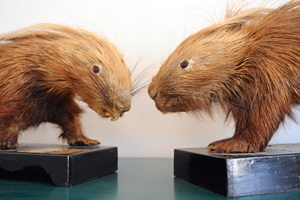
confined behind glass, but casually placed on top of the cabinets: a hedgehog
and a pair of porcupines (pictured). The latter are lined up nose to nose, as
if in friendship or confrontation (who can tell with a porcupine, especially
when stuffed?). Their natural sleekness is enhanced by a doubtless inauthentic
glaze which has been applied to their prickliness, and there is something about
them--no doubt something rather low and anthropomorphising--which inevitably
puts a goofy smile on your face. In the same way, the monotony of massed
seashells on display will be suddenly broken by examples of such an eerie
elegance that they seem the result of modern high-tech design.
So why, you might ask, am I recommending
this place? Partly for the feel of it, for a sense of the mind of the man who
assembled it all, and also a sense of the period when such omnivorous
collecting was the natural behaviour of an enlightened person. But mainly
because, here and there, it contains items which rise above the general
level--and beyond that, two great masterpieces. You might think, for instance,
that the stuffed-animal room, in which dozens of less than sprightly looking
specimens are displayed against fading painted backdrops, might be a bit of a
downer. It is, until you spot three animals which for some reason are not
confined behind glass, but casually placed on top of the cabinets: a hedgehog
and a pair of porcupines (pictured). The latter are lined up nose to nose, as
if in friendship or confrontation (who can tell with a porcupine, especially
when stuffed?). Their natural sleekness is enhanced by a doubtless inauthentic
glaze which has been applied to their prickliness, and there is something about
them--no doubt something rather low and anthropomorphising--which inevitably
puts a goofy smile on your face. In the same way, the monotony of massed
seashells on display will be suddenly broken by examples of such an eerie
elegance that they seem the result of modern high-tech design.
* * * * *
And then there are the two
masterpieces. In how many museums has the dutiful but unenthusiastic eye glided
over an endless array of dusty-looking Greek vases which have irritatingly
evaded destruction? How many times have you pretended interest in yet another
scene of one bearded fellow pursuing another round a curved surface with drawn
sword or brandished trident? Even those with supposedly erotic subjects--larky
chaps with inflated thighs and carroty cocks--come to seem as routine after a
while as page three. But here in Cefalu is a fourth-century-BC
crater--a bell-shaped vase for mixing wine and water--of sudden charm, wit and
realism.
It shows a scene at a
fishmonger's. On the left, a balding vendor wields a large knife over a fat
tuna lying on his slab. He has already hacked off the head, which is on the
floor, and a large cut indicates that with his next downward stroke he will
sever the tail. On the right is a very worried-looking customer. He seems to
have justifiable grounds for apprehension: not least, over the size of the
knife being wielded and its proximity to his nose. Then we notice that his
outstretched right hand contains a single modest coin; both his expression, and
that of the fishmonger, imply that at best the poor fellow will be able to
afford the tail--or maybe just the head, which, we now see, points mockingly
upwards from the floor towards the dismayed customer. The scene provides one of
those moments when a piece of art suddenly dissolves time and confirms, however
briefly, our common, comical humanity.
The museum's other
great treasure is even more astonishing. Antonello da Messina (1430-79) is one
of those painters--like Piero della Francesca, or Vermeer--whose surviving
corpus consists of only a few dozen paintings, most of which turn out to be
masterpieces. He is traditionally credited with having introduced oil painting
into Italian art. Vasari has a fantastical account of Antonello travelling to
the Netherlands to wheedle trade secrets out of the aged Jan van Eyck (the only
problem with the story, apart from the total lack of supporting evidence, is
that Antonello would have been about 11 when van Eyck died). Scholars argue
whether he learnt this northern technique directly--if not from van Eyck, then
perhaps from Petrus Christus in Milan--or indirectly: he was the pupil of Niccolo
Colantonio, who had been taught the south-Netherlandish style while at the
court of Naples. What is certain is that Antonello was crucial in spreading the
news. In 1475-76 he was in Venice, where his presence and knowledge had a
reorienting effect on Giovanni Bellini, and thus on the whole subsequent course
of Venetian painting.
His representational skill has an
intensity that often seems miraculous: indeed, his painter son Jacobello used
to sign himself, touchingly and understandably, "the son of Antonello, a
painter of no human kind". Another thing he shares with Piero and Vermeer
is that his output is now scattered throughout the galleries and museums of the
world. Nearby Palermo has an extraordinary blue-draped "Virgin of the Annunciation" who radiates not just
serenity and gravity but also a gently unflinching confidence: this is no
"what me?" Virgin, but one who knows she is up to the task ahead. A
great museum is lucky to own just a single Antonello, and none has more than
the London National Gallery's five. He is one
of those painters you have to travel far and variously to see--and almost
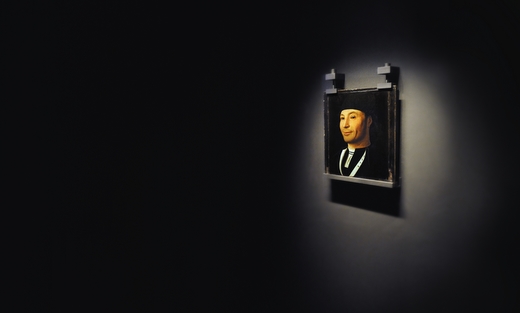
always to a major city. This makes the presence in Cefalu of his "Portrait
of an Unknown Man" (top) all the rarer: can there be an example of a
greater masterpiece in a more obscure museum?
Mandralisca found it mounted on a
pharmacist's cupboard in Lipari: Consolo's novel begins with him standing on
deck, clutching his prize, as the boat brings them back to Cefalu, and the
painting remains a hovering, almost magical presence throughout the book. The
sitter is a man of early middle age, shown in half-to-three-quarter profile.
Antonello had learnt this more open--and potentially more
character-revealing--pose from Flemish artists, at a time when mainland
contemporaries like Piero and Pollaiuolo were still using the strict profile
derived from coins and medals.
The "Unknown Man" wears
a black cap, from which his hair escapes in a slightly unruly fashion at the
back, and a sober black-and-white outfit; the stitching of the buttonholes,
rendered with perfect realism, suggests a certain luxury and carefulness. But
it is his expression which draws us in and holds us. It is confident yet wary,
bold yet withholding. The eye is intelligent, yet sceptical, as is the brow.
The smile is enigmatic, but also somehow mocking--mocking of us. This is a man
who knows the world, and therefore also knows us. His effect is seriously
unsettling: when I showed a postcard of the painting to a leading British art
critic--who had never seen it before--his first response was, "I wouldn't
like to mess with him."
We don't know where this man
lived, or what he did, or what his circumstances were: fancy, and
fiction--perhaps influenced by the fact that Antonello's grandfather had been a
sea-captain--decided he was a sailor, or even a pirate. More sober art
historians have suggested he was a baron, or at least a wealthy man (not that
pirates couldn't be wealthy--it was just that they rarely spent their cash
having themselves immortalised by great painters). All we can safely assume is
that the sitter was successful enough to afford whatever Antonello's
portrait-price was. Equally, we know little about the painting's history before
it entered the baron's collection in 1859. Unsurprisingly, it had suffered
damage down the centuries, and has been restored three times. Though no
documents relating to the work have survived, and different dates have been
guessed at (Berenson settled for just calling it "early"), its
authorship has never been disputed. But this lack of a scholarly back-story is
unimportant: all that matters is the painting's mastery over us, and its
ability to provoke both questions and reverie.
For some interpreters, whether
aesthetes or patriots, the "Unknown Man" has over the years attained
emblematic status, and has come to express the essential withholdingness,
self-control and enigma of the island where the sitter lived. Yet in his
measured, examining way he also feels as close to us today as do that comic
fishmonger and his worried customer. At the Museo Mandralisca, the
"Unknown Man" is kept behind thick glass, safe, we hope, from those
traditional Sicilian threats of earthquake and kidnapping. The glass, on the
day that I visited, was smeary with the noseprints of those eager to penetrate
the picture's secrets. I added my own.
 CEFALU: A QUICK GUIDE
How to get there Fly to Palermo: there are direct
flights with Ryanair from Stansted, Clickair from Barcelona, Wind Jet from
Paris and Venice, and Eurofly from New York (summer only). Cefalu is 50 miles
from the airport and the coastal autostrada makes it an easy drive. There are
buses and trains from Palermo to Messina which stop at Cefalu, and in summer a
daily hydrofoil runs between Cefalu and the lovely, volcanic Aeolian Islands.
When to go Skip the fierce heat of summer
by going in autumn (October to November) or spring (March to May). The museum
is open from 9am to 7pm, all year round, and claims not to take a single day
off.
Where to stay Avoid Cefalu’s humdrum beach
hotels and stay near Palermo at the Grand Hotel Villa Igiea, which has a glorious Mediterranean garden and
private bay (+39 91 631 2111). Or choose the more modest option of Campo
Felice, a stylish B&B in the hills nine miles above Cefalu (+39 91 616 7839).
Picture credit: Camera Press, Chris Warde-Jones
(Julian Barnes is the author of
ten novels and seven other books, most recently "Nothing to be Frightened of")
Copyright © The Economist Newspaper Limited 2008 | All rights reserved