Lives & letters
Brits abroad
When
Guy de Maupassant helped save Algernon Swinburne from drowning off the north
coast of France, he was invited to lunch - an unforgettable experience
involving lots of alcohol, monkey meat and pornography. Julian Barnes on a
bizarre Anglo-French encounter
The Guardian, Saturday October 18 2008
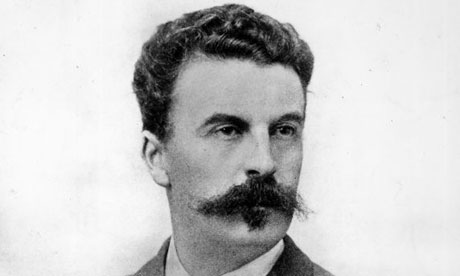
In for a remarkable day ... Guy
de Maupassant. Photograph: Time Life Pictures/Getty
In the first half of the 19th
century, the British began to discover Normandy. Previously, the point of entry
into France for most travellers had been Calais, which felt safely
half-English, and where even the beggars importuned new arrivals in their own
language. Those prepared to make the longer crossing to Dieppe were rewarded
with a greater sense of strangeness: typified by the women in red-and-blue
regional costume, clacking sabots and high white coifs that made them look like
a cross between chefs and nuns. Hazlitt, passing through in 1824, noted that
such headdresses were "much the same as those which the Spectator laughed
out of countenance a hundred years ago in England"; and he concluded more
generally that "In France one lives in the imagination of the past".
For the tourist, this meant antiquities and picturesque ruins within easy reach.
The coastline was a further attraction: for those addicted to the new
health-kick of sea-bathing, to the gentler pleasures of gambling (the casino at
Dieppe opened in 1822), or to painting and sketching. Gradually, the journey
from London became quicker - a combination of the London to Brighton railway
and the new steam-packets brought the time down to a mere 11 hours by the
1840s. For centuries Dieppe's main relationship with Britain had consisted of
suffering occasional bombardment from the Royal Navy; now there were not just
summer tourists, but year-round residents. There was even a quartier des
Anglais (on the hill between the Paris road and the chateau), served by an
Anglican chaplain and a British consul. And since the French more or less simultaneously
decided to make Dieppe a sophisticated destination, the town flourished.
British artists had started
coming here as soon as the Napoleonic wars were over. John Sell Cotman
delighted in the luminous quality of the Dieppe light (it is an unpatriotic
truth that looking north from Dieppe is more visually complex than looking
south from Brighton); Turner came several times in the 1820s; Richard Parkes
Bonington in the 1830s. We tend to associate the Normandy coastline - Etretat,
Pourville, Varengeville, Fécamp - with Monet and the impressionists; but (as
with Cézanne and Mont Sainte-Victoire) previous generations of painters had
preceded them. Boudin, who later taught Monet the principles, and the
necessity, of pleinairisme, painted in Dieppe, as did Corot and Daubigny; while
Delacroix came here in 1850 and 1852. His diary contains an unflattering
depiction of the English colony, whose invitation he had accepted out of
boredom. He went to the salon of a certain Mrs Sheppard, and the next day
rebuked himself: "What a fool you are, getting a sore throat from talking
to idiots, arguing with petticoated silliness for a whole evening, with
everyone going on about God, and 'the justice of the world' and 'good and
evil', and 'progress'!"
Now that the Channel tunnel has
restored most traffic to the more northerly crossing, and the ferry service
from Newhaven runs at unfriendly hours, Dieppe has sunk back into being largely
French again. Serious war damage makes it harder to recreate in the mind the
century - from 1815 to 1914 - during which the town became so fashionable. By
the 1850s it had "the smartest and most popular plage in France"; the
casino was rebuilt at regular intervals, each time more extravagantly; the
British laid out what was only the fourth golf course in France, while the
Paris crowd came down for steeplechasing at the new racetrack. The Prince of
Wales kept a mistress and perhaps an illegitimate child in Dieppe; Lord
Salisbury, while prime minister, built himself a chalet outside the town and maintained
that, thanks to the telegraph station at Beachy Head, he was in better contact
with London than if he had been on a Scottish grouse moor.
Simona Pakenham, who chronicled
Dieppe's Anglo-French entente in 60 Miles from England (1967), commented tartly
that "The English colony was generally indifferent to any form of
culture". But the French needed the arts as the British needed sports. So
Liszt played at the Bains Chauds; Meyebeer came; Rossini composed an operetta
for the theatre. By the end of the 19th century, the casino summer band was
recognised as the best in the country, since it was filled by Parisian
orchestral players on holiday. In 1907, one of its violists was promoted to
conductor, and surprised everyone by directing all Beethoven's symphonies from
memory: this was Pierre Monteux, who six years later conducted the premiere of
The Rite of Spring.
Not all the British visitors were
philistines. The town was Sickert's second home for several decades; and the
British feature strongly in the impressive (and highly cosmopolitan) list of
belle époque visitors to the town. These include Monet, Pissarro, Whistler,
Degas, Renoir, Beardsley, Conder, Fritz Thurlaw (the Norwegian painter), Henry
Harland (the editor of The Yellow Book), William Rothenstein, Proust,
Saint-Saens, Fauré, Debussy, Maeterlinck, Puvis de Chavannes, Percy Grainger,
Adelina Patti, George and Gerald du Maurier, Ernest Dowson, George Moore, Max
Beerbohm, Annie Besant, Marie Tempest, John Barrymore and Gladys Cooper. The
night boat of May 20 1897 brought Oscar Wilde, freshly sprung from Reading jail
and carrying the manuscript of De Profundis. It is a small but interesting
footnote to the history of the Dieppe ferry terminal that the two most
noteworthy events there both involved pseudonyms. In 1848 Louis-Philippe, the
last king of France, heading for exile in England, was hustled aboard a packet
of the General Steam and Navigational Company bearing a passport in the
suspiciously ordinary name of William Smith. Half a century later, Wilde came
ashore, cloaked in the look-at-me alias of Sebastian Melmoth.
The British brought trade, money
and work to Dieppe; they laid the railway, and built the town's station with
English bricks. Neither race was or is as hospitable as they like to imagine
themselves, but a working cordiality existed between the French and the
British. The portrait painter and socialite Jacques-Emile Blanche (1861-1942)
operated for many years as a one-man diplomatic service, summering in Dieppe
and wintering in London: his studio, just beneath the walls of the castle, was
used by Degas, Whistler, Sargent, Boldini, Sickert, Conder, Beardsley and
Helleu. "My dear friend," Henry James said to Blanche, "Your
Dieppe is a reduced Florence, every type of character for a novelist seems to
gather there" - not that the Great Dieppe Novel was ever written. Such
Anglo-French conviviality was helped by a willingness to speak one another's
language. Sickert was regarded as "un vrai Dieppois", even managing
the local fisherfolk's patois; Wilde and Dowson both spoke and wrote excellent
French. So did an English poet whose passing residence along the coast in 1868
led to one of the stranger Anglo-French literary encounters, one that echoed on
for decades, in France at least. It also encapsulated the way the French
preferred to see the British - and perhaps still do.
Etretat, some 50 miles west of
Dieppe, has become a high point of pilgrimage for the artistic faithful, who
gather above its white cliffs - especially the one that curves down into a
great chalk flying-buttress - to compare eroded reality with visual memories of
Monet's pictures. By 1868 the impressionists had not yet arrived: Etretat was a
fishing town that also attracted a certain number of tourists and summer
residents. Among their number that year were the 18-year-old Guy de Maupassant
and his mother (the family chateau of Miromesnil, where Guy had been born, was
a few miles outside Dieppe). The water and its attendant pursuits - swimming,
boating, rowing - were to become a thematic constant in Maupassant's life and
work; so it's appropriate that the water was what provoked the encounter
between this muscular, boastfully heterosexual French prose writer and a petite
homosexual English poet: Algernon Charles Swinburne.
Swinburne, then aged 31, was
staying outside the town in a low thatched cottage belonging to his friend
George Powell. The people of Etretat had Frenchly decided that Powell was a
milord - even if one modestly concealing his real identity under his mother's
maiden name. (In fact, Powell was his real name, and he was uncoroneted. He was
brought up on the family estate at Nanteos, near Aberystwyth, went to Eton and
Oxford, and died at 40.) Maupassant later wrote that Powell's "solitary
and bizarre" way of life had astonished the local bourgeois and mariners
who were "little used to British fantasies and eccentricities"; he
himself was to be afforded a closer look at what such Britishness consisted of.
One September morning, Swinburne
went swimming from the beach at Etretat and got into difficulties. According to
Powell, treacherous undercurrents had carried the poet out to sea "through
a rocky archway" (that very cliff formation Monet later celebrated). Ten
minutes later Powell heard shouts from the clifftop that a man was drowning. He
ran to the water's edge, and after a few minutes received the news that
Swinburne had been safely picked up by a fishing smack heading for nearby
Yport. The poet, writing to his mother (and doubtless downplaying the event),
described "a real sea adventure" in which he had been swept two miles
out: "Luckily I was all right but very tired, and the result was that I
made immense friends with all the fishermen and sailors about - who are quite
the nicest people I ever knew." Maupassant, who was somewhere near the
scene, claimed that the poet had been "dead drunk" (despite it being
ten o'clock in the morning); also, that he himself had gone out in one of the
rescue boats; alternatively, that he had at the very least waded into the water
and got soaked to the waist.
Whatever the specifics of the
near-drowning and the rescue, Maupassant received an invitation to lunch the
next day from the grateful Powell. According to Swinburne (again writing to his
mother), the place where they lived was an idyllic retreat: "Powell has
got the sweetest little farmhouse fitted up with music, books, drawings, etc
... and of course he pokes me into the nicest room ... There is a wild little
garden all uphill, and avenues of trees about. The sea is splendid, and the cliffs
very like the Isle of Wight - two arches of rock each side of the bay, and one
needle only, exactly like half the Freshwater pair." Maupassant described
his visit to the cottage on three separate occasions: orally to Flaubert,
Alphonse Daudet and Edmond de Goncourt in February 1875, an account that
Goncourt transcribed into his Journal; in a newspaper article of November 1882
for Le Gaulois ("L'Anglais d'Etretat"); and in his introduction to
the French translation of Swinburne's Poems and Ballads in 1891. Though the
versions overlap and at times contradict one another, the main story line would
have been enough to send the honest burghers of the Isle of Wight scaring up
the libel lawyers.
Maupassant noted "an
inscription over the door which I didn't read on that first occasion" -
though if he had, he would have known more what to expect. There were pictures
everywhere, some "splendid", others more like "the imaginings of
a lunatic". Powell was short and fat, Swinburne short and thin, "with
a pointed face, a hydrocephalous forehead, pigeon-chested, agitated by a
trembling which affected his glass with St Vitus' dance, and talking
incessantly like a madman." Here and there were laid out displays of
bones; while a flayed human hand, supposedly that of a parricide, was the
bohemian equivalent of a talking point. A large pet monkey was noisily present,
being "titillated" by Powell, and trying to shove Maupassant's head
into his glass whenever he took a drink. Lunch included what the Frenchman
assumed to be some kind of fish; though when he asked its name, his host
"replied with a peculiar smile that it was meat, and I could not get any
more out of him." The fact that spirits rather than wine were served with
lunch also struck the young Frenchman as peculiar - though perhaps was not all
that surprising. Many of the British who were attracted to France at this time
(not just artists and writers, but bankrupts, runaway fraudsters and bogus
priests, mixed up with respectable folk seeking to make a pension stretch
further than it did in England) were struck by the cheapness of French spirits
- which also, of course, made them drunker quicker.
After lunch the two Englishmen
brought out some gigantic portfolios and showed young Guy - perhaps in a
misguided attempt to groom him - pornographic photographs taken in Germany, all
of male subjects. "I remember one of an English soldier masturbating on a
pane of glass." Powell was by this time very drunk, and kept sucking the
fingers of the flayed hand (which was apparently used as a paperweight). A
young servant came in, and the portfolio was swiftly closed. In these exotic
and ghoulish surroundings, the conversation proceeded at the highest cultural
level. Swinburne, who had published his first series of Poems and Ballads two
years previously, and was already notorious in his own country, displayed
"an immense fund of learning". He translated some of his poems into
French for Maupassant's benefit, and enthused about Victor Hugo (whose entry in
the Encyclopaedia Britannica he was subsequently to write). Powell for his part
had been to Iceland and brought back a store of old songs and legends which he
had translated. The two men struck Maupassant as "singularly original,
remarkable and bizarre", a pair of hallucinatory visionaries in the
tradition of Poe and ETA Hoffmann. "If genius," he concluded,
"is, as people say, a kind of delirium of the higher intelligence, then
Algernon Charles Swinburne is assuredly a genius."
Maupassant accepted a second
invitation to lunch a few days later. This passed more peacefully, since the
intrusive monkey was now dead, hanged from a tree by the young servant. Powell
had ordered a huge block of granite for its tomb. At the end of the meal the
two visionaries gave the Frenchman some liquor which nearly knocked him out;
taking fright, he fled back to his hotel. Even so, he made one last visit, in
the course of which he drew attention to the inscription above their door. It
read: Chaumière de Dolmancé (Dolmancé's Cottage). Maupassant asked the
Englishmen if they knew who Dolmancé was (the hero and homosexual corrupter of
Sade's La Philosophie dans le Boudoir). They said that indeed they did.
"Then that is the sign of the house?" Maupassant asked. "If you
like," they replied, "with terrifying expressions on their
faces." The Frenchman again fled, avoiding Swinburne and Powell
thereafter.
The account in the Goncourt
Journal, as translated and edited by Robert Baldick (OUP, 1962), breaks off at this
point. Perhaps for reasons of space, but more likely for reasons of taste in
that only just post-Chatterley era, the rest of the French text was excised. In
it, Maupassant continued:
Yes, they lived there together,
satisfying themselves with monkeys or with young servant lads of fourteen or
fifteen, sent out to Powell from England every three months or so: little
servant boys of exquisite cleanness and freshness. The monkey that slept in
Powell's bed and shat in it every night was hanged by the servant boy, partly
out of jealousy but also out of annoyance at having to change the sheets all
the time.
The house was full of strange
noises and the shadows of sadism; one night, Powell was seen and heard firing a
revolver in the garden at a black man. Those two were real Sadeian heroes, who
wouldn't have held back even from crime. Then this house, so full of living
mystery, was suddenly silent, suddenly empty. Powell just disappeared, and no
one knew how he had got away. No carriage was ever called for him, and no one
had met him on the roads.
This is a rather novelistic
ending, perhaps unsurprising given that Maupassant had had seven years to work
up the story, and that it was being both told, and written down, by a fiction
writer. At other times he ended the story differently. The 1882 account
concludes with Maupassant going back to the Sadeian cottage a couple of years
later, discovering that its contents were being sold off, and buying, as a
souvenir of the two Englishmen, the parricide's flayed hand. The block of
granite had by now been raised into the monkey's sepulchre, and the incident
with the revolver is given fuller explanation. It was the young servant who was
black, and it was he who was being shot at by an enraged Powell for having
hanged the monkey. "Afterwards, the lad wandered around for days without
food or a roof over his head, and then reappeared and began to sell
barley-sugar in the streets of Etretat. He was finally expelled from the
district after having very nearly strangled a customer who complained about his
goods."
Maupassant's later versions also
elaborate on the suspicious protein the Englishmen served. In his 1882 account,
he strongly suspects that it might have been monkey, not least because it was
said to be common knowledge in Etretat that "this Englishman [Powell] ate
only monkey - boiled, roasted, sautéed, or in a confit". By the time of
the 1891 account, Maupassant claims he had knowingly eaten spit-roasted monkey
- indeed, the joint had been ordered in his honour from a purveyor of exotic
meats in Le Havre. However, "The mere smell of the dish as I entered the
house made me feel queasy, and the dreadful taste of the animal permanently
removed all subsequent desire ever again to repeat such a meal."
This gastronomic queasiness did not
imply any broader moral or social revulsion; quite the contrary. Maupassant,
doubtless hoping to provoke readers of Le Gaulois, concluded his 1882 account
thus: "The world would be a lot jollier if one came across ménages like
that one a little more often." He certainly played up the theme of the
innocent young Frenchman (even if one already alive to Sadeian reference)
falling into a nest of genial English perverts intent on displaying national
characteristics. Goncourt deliberately drew on Maupassant's description of
Swinburne and Powell when writing his novel La Faustin (1882), in which an
18th-century English sadist called George Selwyn not only displays many of
Swinburne's mannerisms, but also happens to retire to a cottage on the coast
called Chaumière de Dolmancé. However, all of Maupassant's versions, despite
their dwelling on perversity, are underpinned by deep admiration for the duo:
for their literary and artistic passion, their rejection of bourgeois living,
their recklessness and bravado.
The French have traditionally
regarded biography as a rather low form, being either mere gossip, or at best a
reductive process, one that tethers the work to the life, rather than
recognising the extent to which the work flies free of it. The Anglo-Saxon tradition
is more tethering and more moralising; the biographer's overt or tacit
intention too often being, as John Updike has put it, to "reduce
celebrities to a set of antics and ailments to which we can feel
superior". Whereas it never occurred to Maupassant to feel superior, or
think that Swinburne's extravagant life in any way invalidated, diminished or
necessarily coloured his work. This is partly a matter of Flaubertian
aesthetics; partly the consequence of how the French saw, and to some extent
still see, the British. They think of us as polite, unspontaneous beings
trained to such control and self-control that sometimes the lid has to blow
off, both in art and life. Hence our personal eccentricities and a line of
artistic non-conformity. Contemporary British writers are still being fitted
into this historic schema. I remember once trying to keep a straight face when
a French journalist, seeking to place me in my proper English context, proposed
that my key literary ancestors were Laurence Sterne, Lewis Carroll and Monty
Python. Of course I enthusiastically agreed.
Maupassant never doubted that
Swinburne was a genius. "He is a poet of exalted and frenzied lyricism,
who is not in the least interested in the humble, decent reality which
contemporary French artists obstinately and patiently seek; rather he strives
to depict dreams and subtle thoughts which are sometimes ingenious and grand,
sometimes inflated, but even so magnificent." And it was the same when
other British writers and artists of the time came up for French description
and judgment. The French expected them to behave in peculiar ways, but declined
to allow amusement or shock at their habits to affect aesthetic judgment.
Jacques-Emile Blanche wrote of Sickert living in Dieppe for "thirty years,
married, divorced, remarried, widower, or about to remarry", moving
between smart society and the obscure lodgings he shared with a red-haired
fishmongress, and doing crazy things such as cutting off his hair to surprise a
small girl; and in all those 30 years nobody ever saw him paint. None of this
stopped the French accepting him as a true Dieppois and a true artist: "He
was to be the painter of Dieppe. No other artist so perfectly felt and
expressed the character of the town, whose Canaletto he has become."
Degas's judgment on Wilde, after the 28-year-old Oscar had visited the
painter's Paris studio, was: "He behaves as if he's playing Lord Byron in
some suburban theatre." Goncourt called Wilde un puffiste (a braggart, a
blagger), and thought even his homosexuality wasn't particular to himself, but
imitative, if not plagiaristic: he had copied it from Verlaine, and also from
Swinburne. The diarist Jules Renard wrote cuttingly, "He has at least the
originality of being an Englishman" - the French never quite got hold of
Wilde's Irish connection. But while they saw him as a false human being, they
judged him a true poet.
The British who disembarked at
Dieppe the century before last were often surprised by the cheerful affability
of the people they encountered. When Hazlitt was staying in Dieppe, "A man
and woman came and sang 'God Save the King' before the windows of the Hotel, as
if the French had so much loyalty at present that they can spare us some of
it." (Hazlitt correctly noted that a reciprocal gesture beneath the
windows of a Brighton or Dover hotel would be highly improbable.) A year after
the incident at Etretat, Swinburne returned to stay with Powell at the
Chaumière de Dolmancé once again. In the town, he was "rather astounded at
finding myself rushed at, seized by the arms and legs, hoisted and cheered, and
carried all down the street with shouts of welcome, by the fisher folk and
sailors who knew me again at once". Powell said to him, "Why, don't
you know you're their hero?" - a status Swinburne thought unmerited by the
mere act of not quite drowning.
The poet memorialised his time on
the Normandy coast in two ways. For the rest of his life he kept the
"outsize garments" (outsize because he was so tiny) in which the
rescuing fishermen had dressed him. And in his 1883 collection, A Century of
Roundels, he published a poem called "Past Days":
Above the sea and sea-washed town
we dwelt,
We twain together, two brief summers, free
From heed of hours as light as clouds that melt
Above the sea.
The poem is partly a lament - for
the dead Powell, and for passing time; also an idyll recreating "the days
we had together" among "The Norman downs with bright grey waves for
belt" and the "bright small seaward towns". It is singularly
lacking in references to monkey meat or Sadeian practices. Despite Swinburne's
considerable reputation in France, it seems that he and Maupassant never again
met. What Maupassant, or his heirs, did with the flayed human hand is not
recorded.
• Misfits in France, a three-part
series presented by Julian Barnes and Hermione Lee, will be broadcast on Radio
4 at 11.30am on Thursdays October 23 and 30 and November 6.
http://www.guardian.co.uk/books/2008/oct/18/algernon-swinburne-guy-de-maupassant
guardian.co.uk © Guardian News and Media Limited 2008