
| Eric Arthur Blair (later George Orwell) was born in 1903 in the Indian
Village Motihari, which lies near to the border of Nepal. At that time
India was a part of the British Empire, and Blair's father Richard ,held
a post as agent in the Opium Department of the Indian Civil Service. Blair's
paternal grandfather too had been part of the British Raj ,and had served
in the Indian Army. Eric's mother ,Ida Mabel Blair ,the daughter of a French
tradesman, was about eighteen years younger than her husband Richard Blair
. Eric had a elder sister called Marjorie. The Blairs led a relatively
privileged and fairly pleasant existence, in helping to administer the
Empire. Although the Blair family was not very wealthy - Orwell later described
them ironically as "lower-upper-middle class" . They owned no property,
had no extensive investments; they were like many middle-class English
families of the time, totally dependent on the British Empire for
their livelihood and prospects. In 1907 when Eric had about eight years ,the family returned to England and lived at Henley, though the father continued to work in India until he retired in 1912. With some difficulty ,Blair's parents sent their son to a private preparatory school in Sussex at the age of eight. At the age of thirteen he won a scholarship to Wellington, and soon after another to Eaton ,the famous public school. 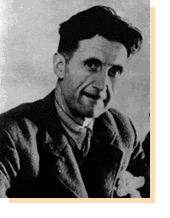 His parents had forced him to work hat at a deary preparatory school,
and now after winning the scholarship, he was not any more interested in
further mental exertion unrelated to his private ambition.
However he has finished the final examinations at Eaton as 138th of 167. He neglected to win a university scholarship, and in 1922 Eric Blair joined the Indian Imperial Police. In doing so he was already breaking away from the path most of his school-fellows would take, for Eaton often led to either Oxford or Cambridge. Instead he was drawn to a life of travel and action. He trained in Burma, an served for five years in the police force there. In 1927,while home on leave, he resigned. There at least two reasons for this: firstly ,his life as a policeman was a distraction from the life he really wanted, which was to be a writer; and secondly, he had come to feel that, as a policeman in Burma, he was supporting a political system in which he could no longer believe. Even as early as this his ideas about writing and his political ideas were closely linked. It was not simply that he wished to break away from British Imperialism in India: he wished to "escape from ... every form of man's dominion over man", as he said in Road to Wigan Pier (1937), and the social structure out of which he came dependent ,he saw it, on just that dominion over others" - not just over the Burmese ,but over the English working class. Back in London he settled down in a grotty bedroom in Portobello Road. There, at the age of twenty-four, he started to teach himself how to write. His neighbours were impressed by the determination . Week after week he remained in his unheated bedroom ,thawing his hands over a candle when they became too numb to write. In spring of 1928 he turned his back on his own inherited values, by taking a drastic step. For more than one year he went on living among the poor frist in London then in Paris. For him the oor were victims of injustice, playing the same part as the Burmese played in their country. One reason for going to live among the poor was to over come a repulsion which he saw as typical for his own class. At Paris he lived and worked in a working-class quarter. At the time, he tells us, Paris was full of artists and would-be artists. There Orwell led a life that was far from bohemian ,when he eventually got a job, he worked as a dishwasher. Once again his journey was downward into the life to which he felt he should expose himself, the life of poverty-stricken ,or of those ho barely scarped a living. When ha came back to London, he agian lived for a couple of months among the tramps and poor people in London. In December 1929 Eric spent Christmas with his family. At his visit he announced that he's going to write a book about his time in Paris. The original version of Down And Out entiteled A Scullion's Diary was completed in October 1930 an came to only 35,000 words for Orwell has used only a part of his material. After two rejections from publishers Orwell wrote Burmese Days (published in 1934), a book based on his experiences in the colonial service. We owe the rescue of Down and Out to Mabel Firez: She was asked to destroy the script, but save the paper clips. Instead she took the manuscript and took it to Leonard Monroe, literary agent at the house Gollancz, and bullied him to read it. Soon it was accepted - on condition that all swearwords were deleted and certain names changed. Having completed this last revision Eric wrote to Victor Gollancz:'...I would prefer the book to be published pseudonymously. I have no reputation that is lost by doing this and if the book has any kind of success I can always use this pseudonym again.' But Orwell's reasons for taking the name Orwell are much more complicated than those writers usually have when adopting a pen-name. In effect it meant that Eric Blair would somehow have to shed his old identity and take on a new. This is exactly what he tried to do: he tried to change himself from Eric Blair, old Etonian an English colonial policemen ,into George Orwell, classless antiauthoritarian. Down And Out In Paris And London, was not a novel; it was a kind of documentary account of life about which not many of those who would read the book and the time would know very much. And this was the point of it: he wished to bring the English middle class, of which he was a member, to an understanding of what life they led an enjoyed, was founded upon, the life under their very noses. Here we see two typical aspects of Orwell as a writer: his idea of himself as the exposer of painful truth, which people for various reasons do not wish to look at; and his idea of himself as a representative of the English moral conscience .(Winston Smith - 1984 - last representative of moral ). His next book was A Clergyman's Daughter (1935) and Keep The Aspidistra
Flying (1936). Then he opened a village shop in Wallington, Hertfordshire,
in 1936, where he did business in the mornings, and wrote in the afternoons.
The same year he married Elieen O 'Shaughnessy. In that year also , he
received a commission from the Left Book Club to examine the conditions
of the poor and unemployed. This resulted in The Road to Wigan Pier. He
went on living among the poor about whom he was to write his book. Once
again it was a journey away from the comparative comfort the middle class
life. His account of mining communities in the north of England in this
book is full of detail, and conveys to the reader what is like to go down
a mine. When the Left Book Club read what he had written about the English
class system and English socialism in the The Road to Wigan Pier they were
not pleased , and when the book was published it contained a preface by
Victor Gollancz taking issue with many of Orwell's main
Having completed The Road to Wigan Pier he went to Spain at the end
of 1936, with the idea of writing newspaper articles on the Civil War which
had broken out there. The conflict in Spain was between the communist,
socialist Republic, and General Franco's Fascist military rebellion. When
Orwell arrived at Barcelona he was astonished at the atmosphere he found
there: what had seemed impossible in England seemed a fact of daily life
in Spain. Class distinction seemed to have vanished. There was a shortage
of everything, but there was equality. Orwell joined in the struggle, by
enlisting in the militia of POUM (Partido Obrero de Unificación
de Marxista), with which the British Labour Party had an association. For
the first time in his life socialism seemed a reality, something for which
is was worth fighting for. He was wounded in the throat. Three and a half
month later when he returned to Barcelona ,he found it a changed city.
No longer a place where the socialist word comrade was really felt to mean
something, it was a city returning to "normal". Even worse, he was to find
that his group he was with, the POUM, was
In 1938 Orwell became ill with tuberculosis, and spent the winter in Morocco. While there he wrote his next book, a novel entitled Coming up for Air, published in1939, the year the long threatened war between England an Germany broke out. Orwell wanted to fight, as he has done in Spain, against the fascist enemy, but he was declared unfit. In 1941 he has joined the British Broadcasting Corporation as talks producer in the Indian section of the eastern service. He served in the Home Guard, a wartime civilian body for local defence. In 1943 he left the BBC to become literary editor of the tribune, and began writing Animal Farm. In 1944 the Orwells adopted a son, but in 1945 his wife died during an operation. Towards the end of war Orwell went to Europe as a reporter. Late in 1945 he went to the island of Jura off the Scottish coast, and settled there in 1946. He wrote Nineteen Eighty-Four there. The islands climate was unsuitable for someone suffering from tuberculosis and Nineteen Eighty-Four reflects the bleakness of human suffering, the indignity of pain. Indeed he said that the book wouldn't have been so gloomy had he not been so ill. Later that year he married Sonia Bronwell. He died in January 1950. |